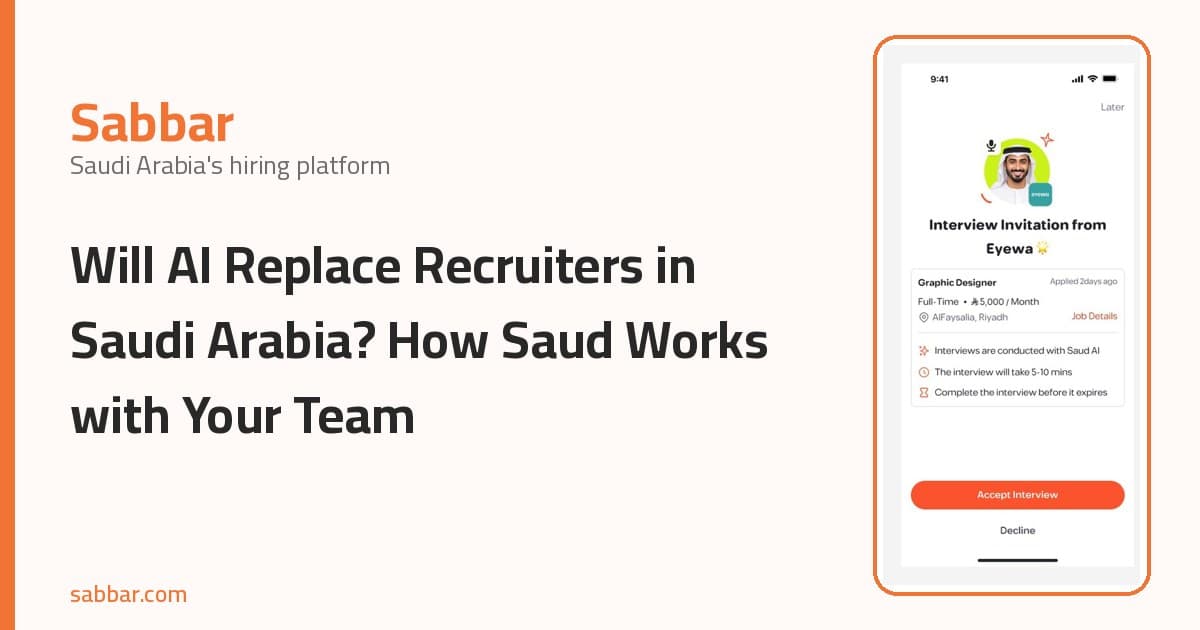
Every recruiter has heard the question, and perhaps asked it privately: will AI replace recruiters? The short answer is no. AI takes the repetitive tasks out of your day and leaves what truly needs a person.
This article answers the question plainly and explains how Saud, Sabbar's AI hiring assistant, works alongside a hiring team rather than instead of it.
What you will learn
- A direct answer on whether recruiters will be replaced.
- The tasks AI takes on and those that stay human.
- How a recruiter's day changes with Saud.
- The skills that grow in value.
Will AI replace recruiters?
No, AI will not replace recruiters. It replaces specific tasks in their work: reading hundreds of CVs, first calls and coordinating slots.
The decision, the judgment about a person, persuading a candidate and understanding what a manager needs all stay human. Saud is designed on that basis: he rates, explains and leaves the decision to your team. See What Is Saud by Sabbar?.
Which tasks does Saud take on?
Saud takes on five repetitive tasks, all in the early stages.
- Drafting the job description: through "Write with Saud".
- Rating fit: marking each applicant Good Fit or Close Fit with a reason.
- The first interview: on WhatsApp by text or voice.
- Interview scheduling: inside the availability you set.
- Pre-interview follow-up: to reduce no-shows.
These tasks repeat hundreds of times in the same shape, which is why they suit automation.
What stays with the recruiter?
Everything that needs judgment and relationship stays with the recruiter.
- Understanding the need: what the branch manager really wants, not what the request says.
- Setting the criteria: what is essential and what is preferred.
- The final interview: reading character and team fit.
- The decision: who gets hired.
- Persuasion and negotiation: especially with a candidate holding other offers.
- Special cases: a candidate with an unusual path who deserves a chance.
- Candidate experience: the impression your company leaves.
Want to see how the work splits between Saud and your team? Book a Saud demo and see the result on a real role.

Sabbar is Saudi Arabia's leading local hiring platform
The go-to place for job seekers and employers across every sector in the Kingdom, with more than 1.5 million job seekers and thousands of companies
Get started with Sabbar today!
How does a recruiter's day change with Saud?
The day shifts from execution to review and decision.
Before Saud
The day starts with a long applicant list. Hours of reading, then calls that half the candidates do not answer, then coordination messages, and the day ends without a single final interview.
With Saud
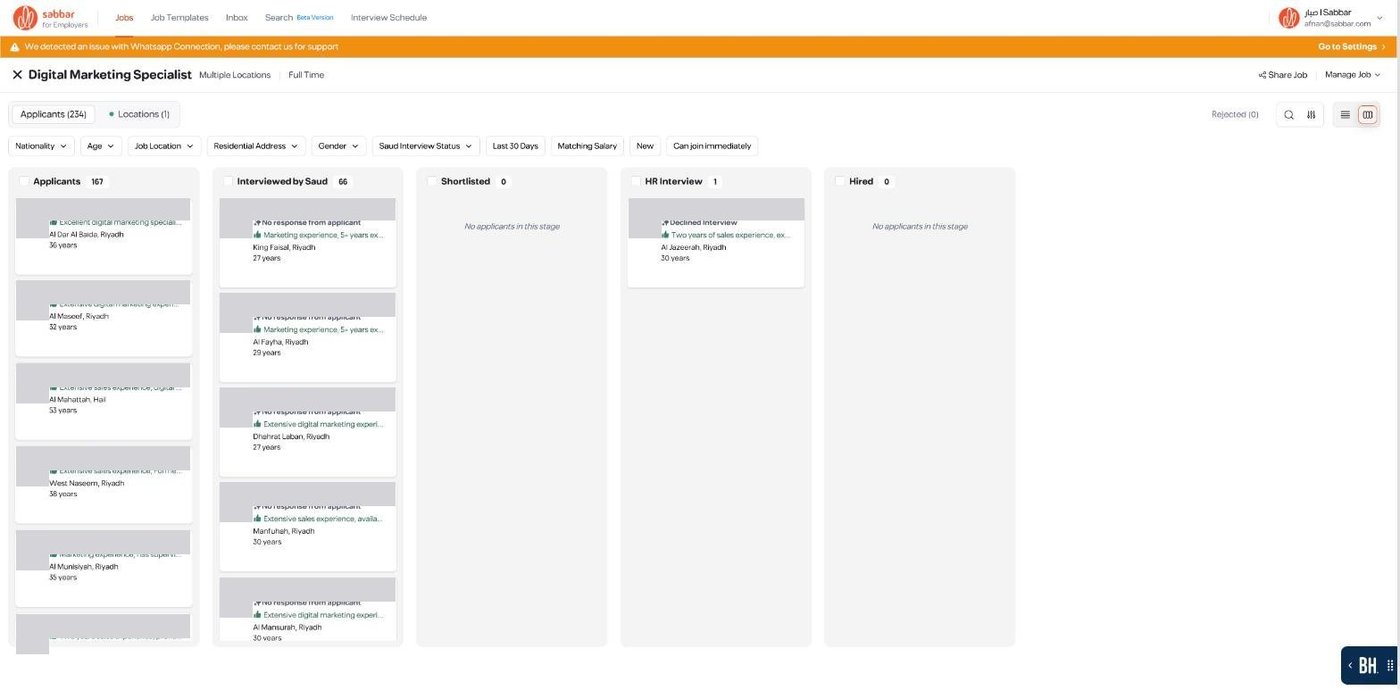
The day starts with a ranked list: who Saud interviewed, the fit verdict and his notes. The recruiter reads the summaries, moves the best to the shortlist, and spends time on final interviews and with branch managers.
Are Saud's verdicts binding?
No, Saud's verdicts are not binding. He gives a verdict and a reason; the team decides.
- Every applicant stays on your list, whatever the rating.
- You can open any profile and read the CV and the full transcript.
- You move a candidate to the shortlist or dismiss them.
- You set the criteria and questions, and Saud works within them.
Which recruiter skills grow in value?
As repetitive tasks are automated, six skills gain value.
- Reading data: understanding interview summaries and hiring metrics.
- Writing criteria: clear requirements and good questions.
- Deep interviewing: situational and behavioural questions.
- Partnering with managers: turning a business need into a role profile.
- Building the employer's reputation.
- Regulatory knowledge: labour rules, Saudization and contract documentation.
What about small teams?
Small teams benefit most. One recruiter for twenty branches cannot call three hundred applicants. With Saud, the same person handles more volume without turning into a call machine.
In businesses with no recruiter at all, the owner or branch manager gets a ranked list instead of reading everything alone.
A real example: Chez Ayah, a small business with no HR department, handed screening and first interviews to Saud, kept the final decision, and built a team of about 6. See how Chez Ayah hired with Saud.
What are AI's limits in hiring?
AI has clear limits, and it helps to know them.
- It knows your team's culture only from what you write for it.
- It depends on the quality of your requirements: vague ones give weak screening.
- It does not replace an in-person interview for roles that need presence.
- It does not carry legal responsibility for the decision; the employer does.
That is why human review, and criteria tied only to the job, are always advised.
How do you start without worrying your team?
- Explain that the goal is to lighten repetitive tasks.
- Start with one high-volume role.
- Let the recruiter set the criteria and questions.
- Review the first batch of summaries together.
- Measure the time freed and invest it in final interviews.
A wider view is in AI in HR in Saudi Arabia.
Small team, many vacancies? See Saud for employers as an assistant who works with you, not in your place.
An illustrative example: a recruiter six months into working with Saud
This illustrates how the role changes; it is not a real case. A recruiter at a restaurant chain was covering roles for fifteen branches on her own.
Before: most of her week went on first calls and scheduling. She had no time to visit branches and did not know why new hires kept resigning at two of them.
Six months later:
- She reviews first-interview summaries each morning instead of making the calls.
- She joins the important final interviews with branch managers and coaches them on situational questions.
- She visits the two branches with high resignations and finds the problem is the shift rota.
- She adjusts Saud's criteria and questions each month, based on who succeeded and who left.
- She gives management a monthly report on time to fill and retention.
Her job did not disappear. It moved from making calls to improving hiring itself, and her effect on the business became clearer.
A four-part development plan for recruiters
If you are a recruiter and want to keep your value high, these are practical areas to start on this month.
- Behavioural interviewing: practise "tell me about a time" questions, and listening more than talking.
- Numbers: track three indicators per role, such as time to fill, attendance and retention at three months.
- Knowing the work itself: spend a day in a branch or department you hire for, to understand what the job description leaves out.
- Labour regulations: follow updates on Saudization and contracts. Managers turn to you for them.
Questions to ask about any tool before trusting its verdict
Blind trust in a tool is a mistake, and so is rejecting it untested. Ask these questions.
- Does it explain the verdict? A rating with no reason cannot be reviewed.
- Can I see what the candidate actually said? The interview transcript should be available.
- Who sets the criteria? It should be you.
- Is anyone removed without my knowledge? The full list should stay in front of you.
- What happens if I disagree with the verdict? Your decision should be the one that counts.
On Sabbar, Saud gives the verdict with its reason, the full transcript is on the profile, and nobody is removed from your list.
How to review Saud's work in the first month
Regular review at the start builds trust based on evidence and shows what needs adjusting.
- Read five full transcripts a week: do not rely on the summary alone in the first weeks.
- Compare his verdict with yours: where you disagreed, why?
- Check the Close Fits: did any deserve Good Fit? If that keeps happening, your requirements need adjusting.
- Follow those who were hired: did the people rated Good Fit actually succeed in the job?
- Adjust the requirements: the tool works on what you write.
Candidates' concerns and how a recruiter reassures them
Part of a recruiter's role today is explaining to candidates how the process works.
- "Will a program reject me?": explain that the decision is the team's, and the first interview introduces them to the company.
- "Will anyone read my answers?": yes. The summary and transcript reach the team.
- "What if I am not good at writing?": the interview accepts voice notes.
- "When will I know the result?": commit to a timeframe and tell them. That is the human's responsibility, not the tool's.
Give your hiring team an AI assistant, not a replacement
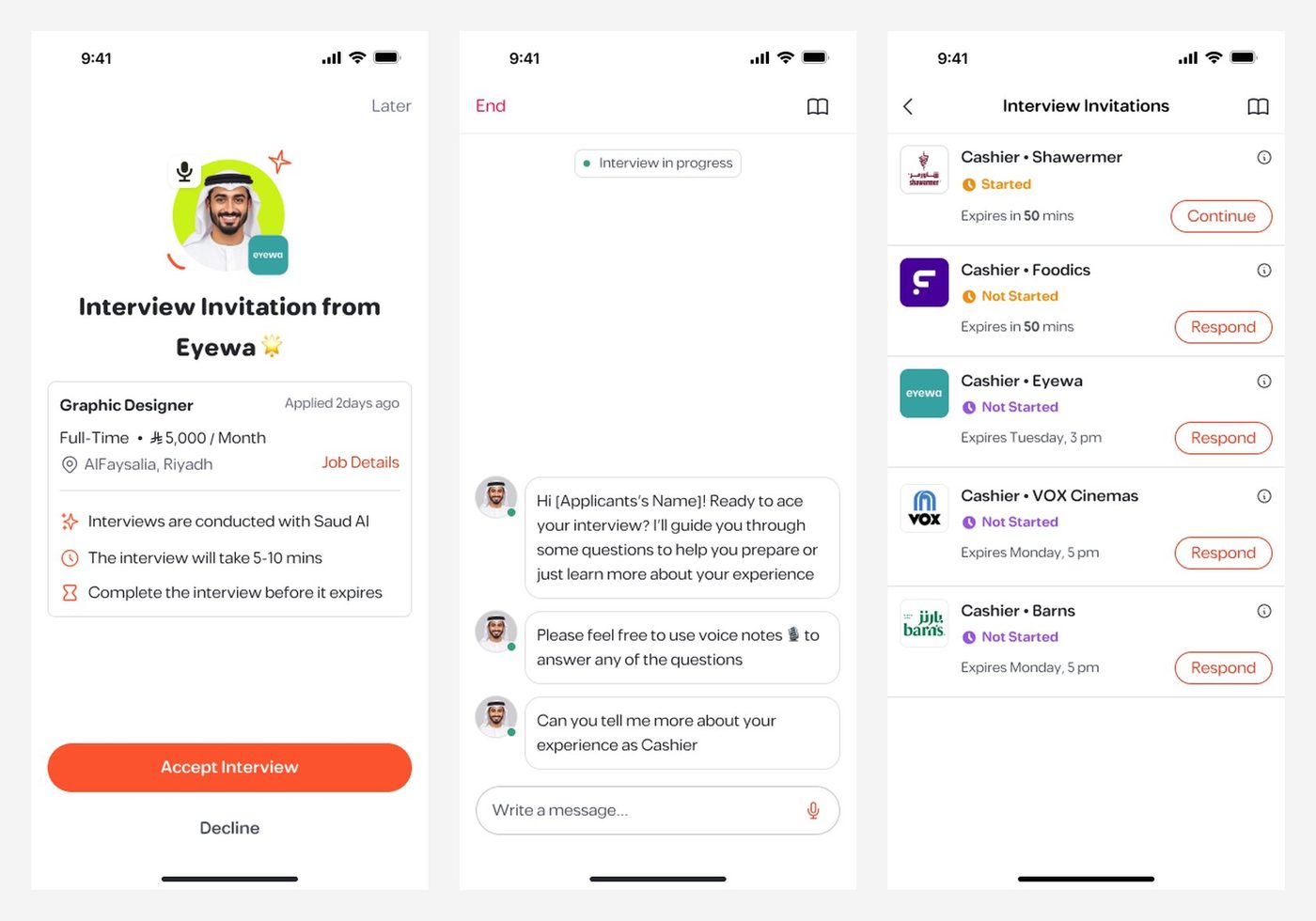
Saud handles screening, the first interview and coordination, while your team focuses on the decision and the final interview. Book a demo and see how a recruiter's day changes.
Summary
AI will not replace recruiters; it takes repetitive tasks off their hands. Saud by Sabbar screens, interviews, coordinates and explains his reasons, while the decision, the final interview and the relationship with the candidate stay human.
A few more quick questions
Does Saud hire candidates automatically?
No. Saud does not hire. He rates and interviews and leaves the decision to your team.
Does Saud reject applicants?
No. He only rates. Every applicant stays on your list.
Do I need technical training to work with Saud?
No. His results appear on the applicant's profile inside your company account.
Does Saud help a business with no HR department?
Yes. The owner gets a ranked list and summaries instead of reading every CV.
Does the recruiter's job change?
It shifts from repetitive execution to review, final interviews and partnership with managers.