Every HR manager has heard that AI in HR will change hiring. The practical question is where exactly it saves time and money, and where people still matter.
This article walks through the hiring journey stage by stage and shows what AI shortens at each one, with examples from Saud, Sabbar's AI hiring assistant, and from employers in Saudi Arabia.
What you will learn
- Where hiring time and cost go in the traditional approach.
- The five stages AI shortens.
- What should not be left to the machine.
- How to start small and measure the result.
What is AI in HR?
AI in HR is the use of systems that understand language and data to carry out tasks that used to need a person, such as drafting text, comparing CVs with requirements and holding first conversations.
In hiring specifically, its most mature uses are repetitive, high-volume tasks.
Where do hiring time and cost go?
Most of the time goes on repetitive tasks that need hours rather than expertise.
- Writing the post: a description from scratch for each job.
- Reading CVs: hundreds of files per post.
- First calls: fifteen minutes per applicant, and many do not answer.
- Coordinating slots: back-and-forth for every interview.
- Wasted interviews: candidates who do not show.
- The open vacancy: each day without the employee costs sales and strains the team.
So the cost is not only the posting fee; it is the salaries of the people doing these tasks and the cost of delay. This comparison of full-time versus flexible staffing costs shows how such costs add up.
5 stages AI shortens in hiring
1. Writing the job description
AI drafts the description from the title in seconds. On Sabbar, "Write with Saud" writes the description and duty list in Saudi Arabic, and "Rewrite with Saud" improves your text. The system also highlights phrases that break MHRSD rules.
2. Screening applicants
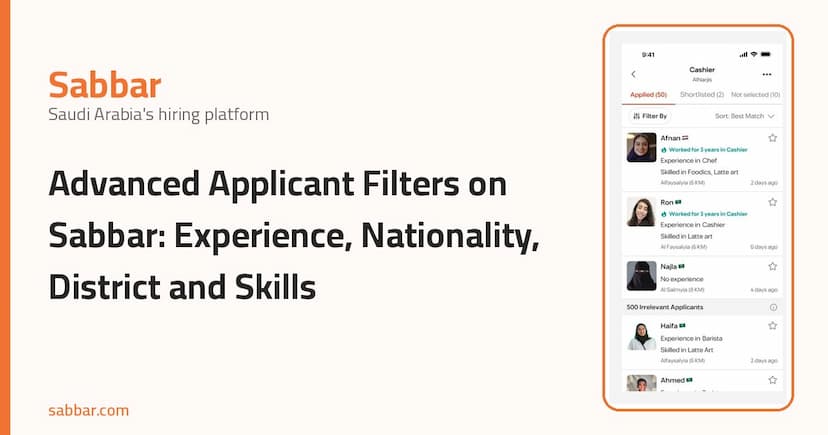
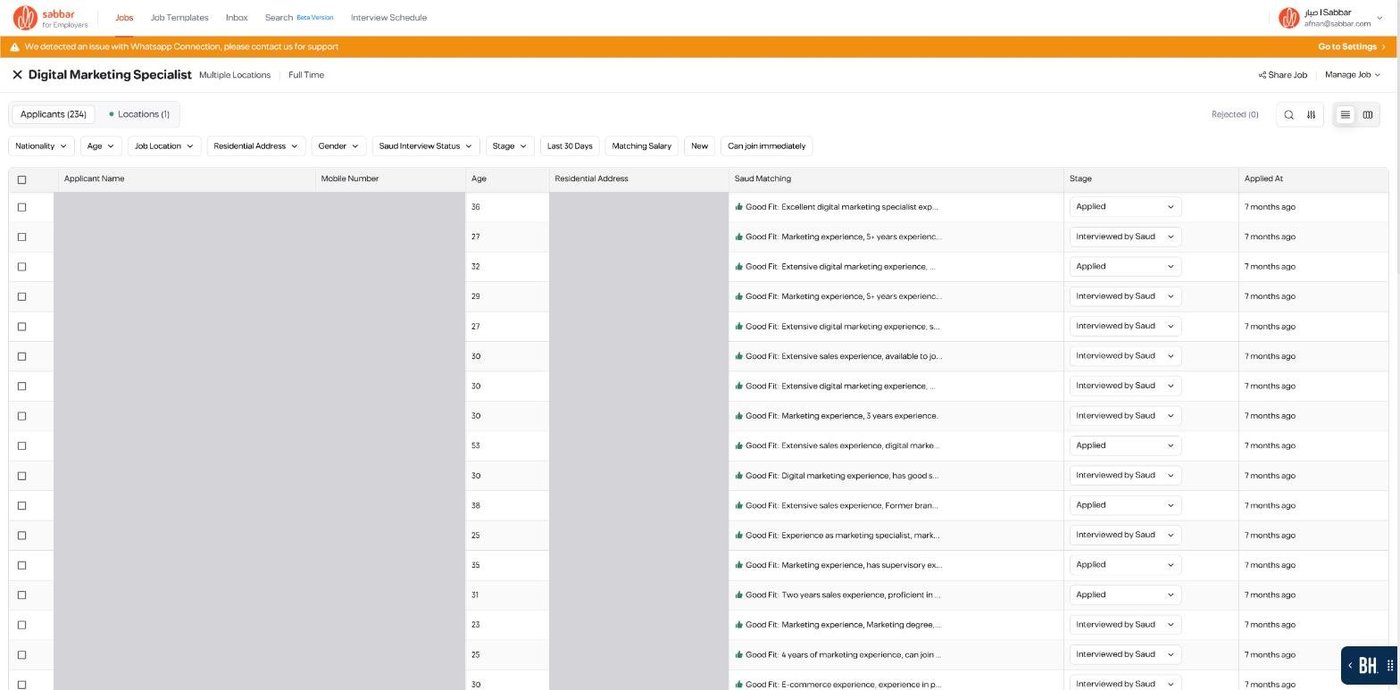
Automated matching compares each applicant with your requirements and rates them Good Fit or Close Fit with a reason. Days of reading become a ready ranking. See AI CV screening in Saudi Arabia.
3. The first interview
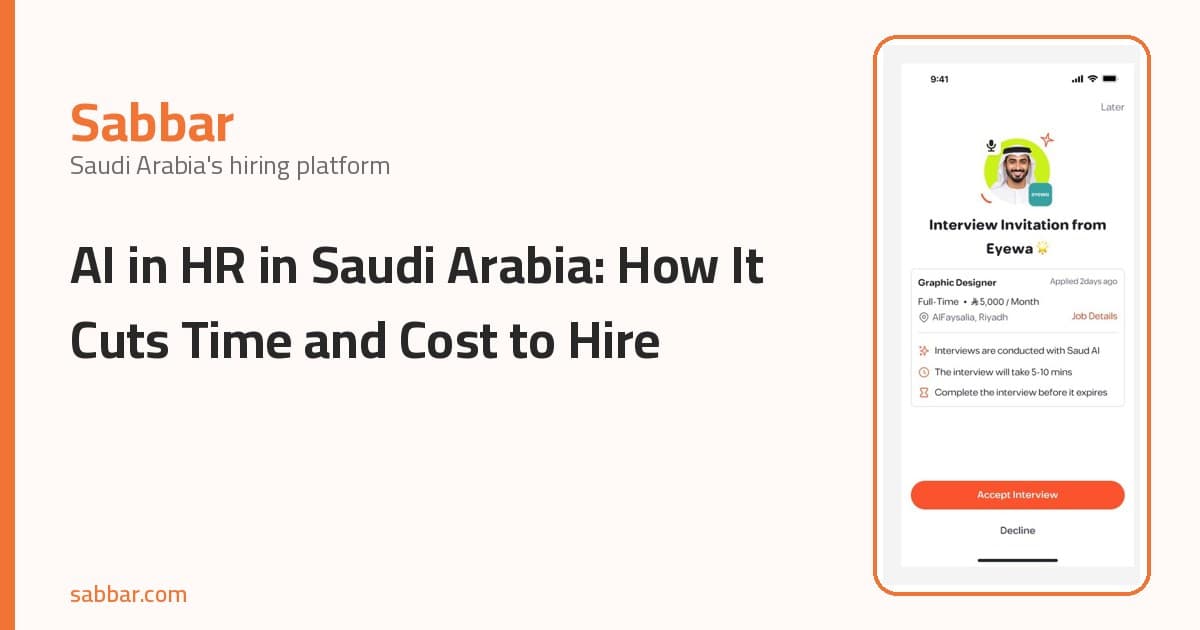
Saud runs the first interview on WhatsApp by text or voice, with dozens of applicants at the same time. Your team receives a verdict, notes and the transcript.
Want to see the five stages on one of your own roles? Book a Saud demo and compare the time before and after.

Sabbar is Saudi Arabia's leading local hiring platform
The go-to place for job seekers and employers across every sector in the Kingdom, with more than 1.5 million job seekers and thousands of companies
Get started with Sabbar today!
4. Interview scheduling
Saud agrees the slot with the candidate inside the availability you set, with no back-and-forth from your team.
5. Pre-interview follow-up
A reminder before the slot reduces no-shows, so branch managers' hours are not wasted. See Candidate no-shows in Saudi Arabia.
How does that show up in cost?
It shows up in cost in four ways, without leaning on generic figures that do not fit everyone.
- Team hours: less time reading, calling and coordinating.
- Speed to fill: fewer days with an understaffed branch.
- Fewer, sharper interviews: you meet the shortlist only.
- Paying when needed: on Sabbar you post for free and pay on contact, and a Saud interview is counted only when it happens.
To know the effect on your business, measure where you are first.
How do you measure the effect?
Measure four simple indicators before and after.
- Time to fill: from posting to start date.
- Team hours per hire: reading, calling and coordinating.
- Interview attendance rate.
- Share of hires who complete probation.
Record the numbers for a month, then compare.
What should not be left to AI?
The final decision and the judgment about a person stay with people.
- The hiring decision: Saud rates and explains; he does not hire.
- The final interview: to read character and team fit.
- Negotiation and the offer.
- Exceptions: a candidate with unusual experience deserves a second look.
- Reviewing the criteria: you decide what is required and what is not.
That is why every applicant stays on your list, whatever their rating.
What do you need to start?
You do not need a technical project. You need three things.
- A post with clear requirements in their fields.
- Someone on the team who reviews results daily.
- A willingness to adjust the criteria after the first week.
How do you start small?
- Choose one recurring role with many applicants.
- Post it on Sabbar and use "Write with Saud".
- Review the fit ratings for the first 48 hours.
- Add Saud AI Interviews through Premium or Premium Plus.
- Compare time and quality with a similar past role.
Why does this matter in Saudi Arabia now?
It matters because the Saudi labour market is moving fast: tourism, entertainment and retail are expanding, Saudization raises demand for national talent, and employers compete for the same candidates. Whoever reaches them first hires better.
Small team, many vacancies? See Saud for employers and start with one role.
An illustrative example: a recruiter's week before and after AI
This illustrates how time is spent; the figures are not from a real company. A recruiter at a retailer is working on three roles at once.
Before: the week starts with a backlog of CVs. Most days go on first calls, many unanswered. Messages go back and forth to fix interview times, and some candidates still do not show. By the end of the week, only a few final interviews have happened.
After:
- Writes the three job descriptions with "Write with Saud" and reviews them.
- Opens the applicant list and finds it ranked by fit rating.
- Reads summaries of the first interviews Saud ran instead of making the calls.
- Finds interviews scheduled and candidates reminded.
- Spends the time on final interviews and talking to branch managers.
The working hours did not change. What changed is the share of time spent deciding rather than coordinating.
A four-week pilot plan
The best way to see what AI does for your company is a small, defined pilot, not changing everything at once.
- Week one, baseline: pick a recurring role and record time to fill, team hours and interview attendance under the current method.
- Week two, run: post the same role with matching and Saud AI Interviews, and enter the requirements in their fields.
- Week three, follow up: review the summaries daily, and adjust the requirements if the ratings do not match your judgment.
- Week four, compare: compare the three numbers, and ask the team and branch managers for their view.
If the result is clear, extend the pilot to other roles. If not, check how clear the post is before judging the tool.
Questions to ask before choosing any AI hiring tool
There are many tools. These questions sort out which are useful for your market.
- Does it really support Arabic? The interface, the job description and the conversation with the candidate.
- Where does the candidate respond? The channel they use every day raises the reply rate.
- Does the tool explain its verdict? A rating with no reason cannot be trusted or reviewed.
- Who makes the final decision? It should stay with your team.
- How is cost calculated? A fixed subscription, or payment for actual use.
- Does it come with candidates, or do you need another source? A screening tool without a job seeker base solves half the problem.
- How does it handle candidate data? Read the privacy notice.
Common concerns in HR teams
Hesitation is natural, and most concerns have a practical answer.
- "It will replace us": the tool takes repetitive tasks. Judgment, the final interview and the relationship with managers stay with the team.
- "It will reject good candidates": on Sabbar, Saud rates and explains and never removes anyone, and you can open any profile.
- "Candidates will not accept it": the interview is a chat the candidate answers in their own time, and the invitation states that it is with an AI assistant.
- "It will not understand our jobs": accuracy depends on how clearly you write the requirements.
- "It will cost more": compare with the cost of team hours and vacancy days, not with the plan price alone.
Where to start if your business is small
A small business does not need a project. It needs three habits.
- Draft the description with AI, then edit it with your own details.
- Rely on the fit rating to decide who to contact first.
- Move to AI interviews only when applicants outnumber the calls you can make.
Cut time and cost to hire with an AI assistant that works with your team
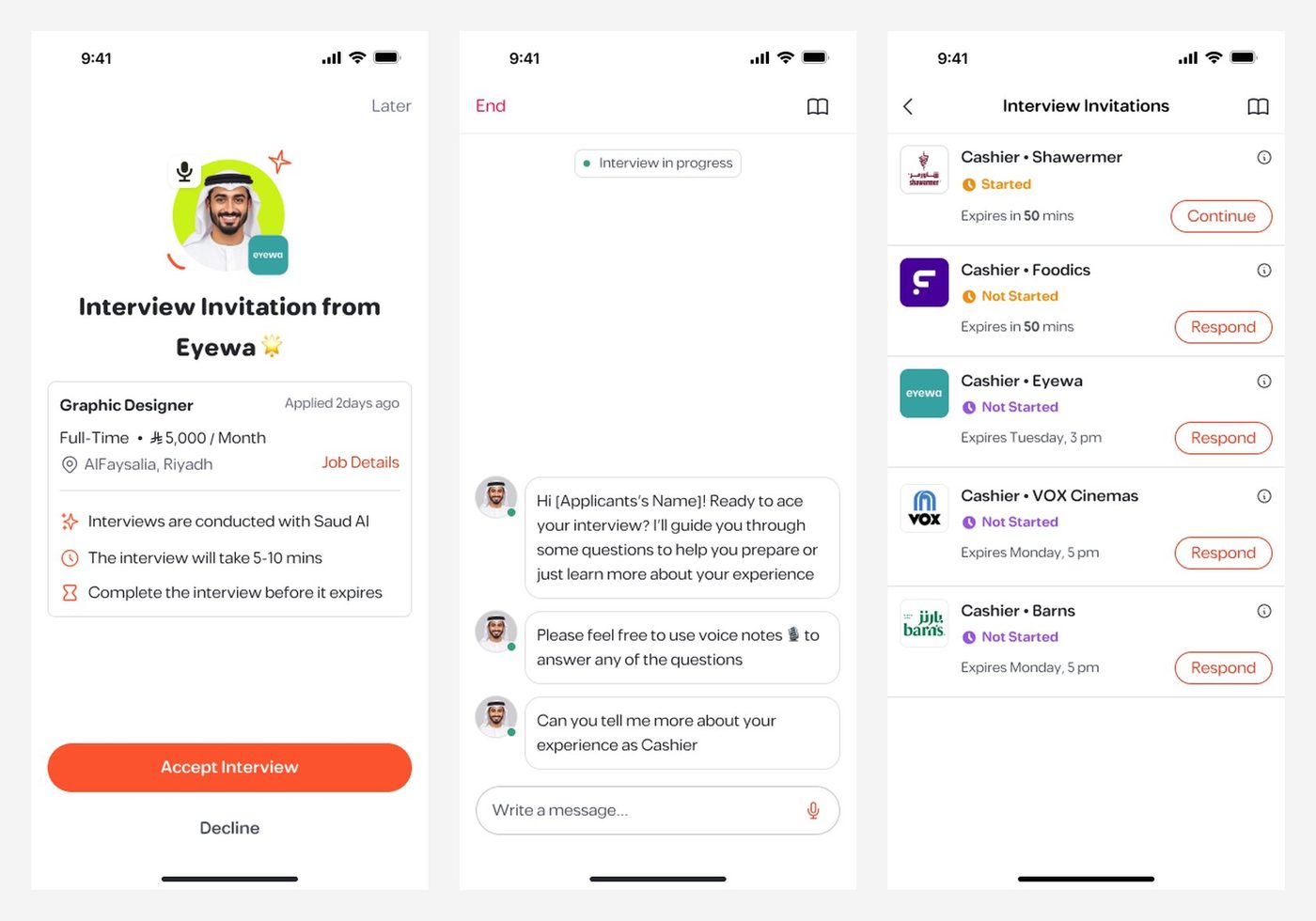
Saud writes the description, screens, interviews, coordinates slots and reminds candidates, while your team keeps the decision. Book a demo and see where he would save you the most.
Summary
AI in HR cuts time and cost to hire at five repetitive stages: the description, screening, the first interview, scheduling and follow-up. The decision stays human. Start with one role, measure four indicators, then expand.
FAQs about AI in hiring
Does using Saud need a technical team?
No. Saud works inside your company's Sabbar account with no technical setup.
Does AI remove the recruiter's role?
No. It moves the recruiter from repetitive tasks to the decision and the final interview.
Does it suit small businesses?
Yes. AI matching is included in every plan, and writing the description with Saud is available when you create a post.
How much time does it save?
It varies by role and applicant volume. Measure time to fill and team hours before and after to find your number.
Are Saud's verdicts final?
No. Saud rates and explains the reason; the final decision is your team's.