You booked a room, cleared an hour in the branch manager's day, and the candidate neither came nor cancelled. A candidate no show is one of the most frustrating parts of hiring in Saudi Arabia, especially for restaurant, retail and customer service roles.
The good news is that most causes can be fixed before interview day. Saud, Sabbar's AI hiring assistant, follows up with the candidate right up to the slot. This article covers the causes and the fixes.
What you will learn
- Why candidates really miss interviews.
- What no-shows cost the business.
- How Saud follows up before the slot.
- Ten practical steps that raise attendance.
What is a candidate no show?
A candidate no show is when a candidate agrees an interview time and then does not turn up, with no notice.
It is different from cancelling. A candidate who cancels in advance lets you fill the slot; a no-show wastes it entirely.
Why do candidates miss interviews?
Candidates miss interviews for practical reasons more than personal ones. The most common:
- A distant date: two weeks between agreeing and meeting is enough to forget or find another job.
- No reminder: a time agreed verbally on a quick call.
- An unclear location: the candidate does not know where the branch is or whom to ask for.
- A long commute: they discover it is an hour away and back out.
- Missing information: no salary or shift details, so enthusiasm fades.
- Another offer: they accepted elsewhere and did not tell you.
- Awkwardness about cancelling: there is no easy way to say they are not coming.
What do no-shows cost the business?
The cost is more than a lost hour.
- The branch manager's or recruiter's time.
- A vacancy that stays open and pressure on the current team.
- Other candidates who got no slot because the calendar was full.
- Frustration that pushes the team to overbook interviews.
In sectors with high turnover, the problem repeats every hiring round.
How does Saud reduce candidate no-shows?
Saud reduces no-shows by dealing with the causes before they happen, in four ways.
Checking commitment early
The first interview with Saud on WhatsApp shows who is really interested. Someone who completed an interview and answered questions about availability and shifts is more committed than someone who only tapped Apply.
A slot the candidate chooses
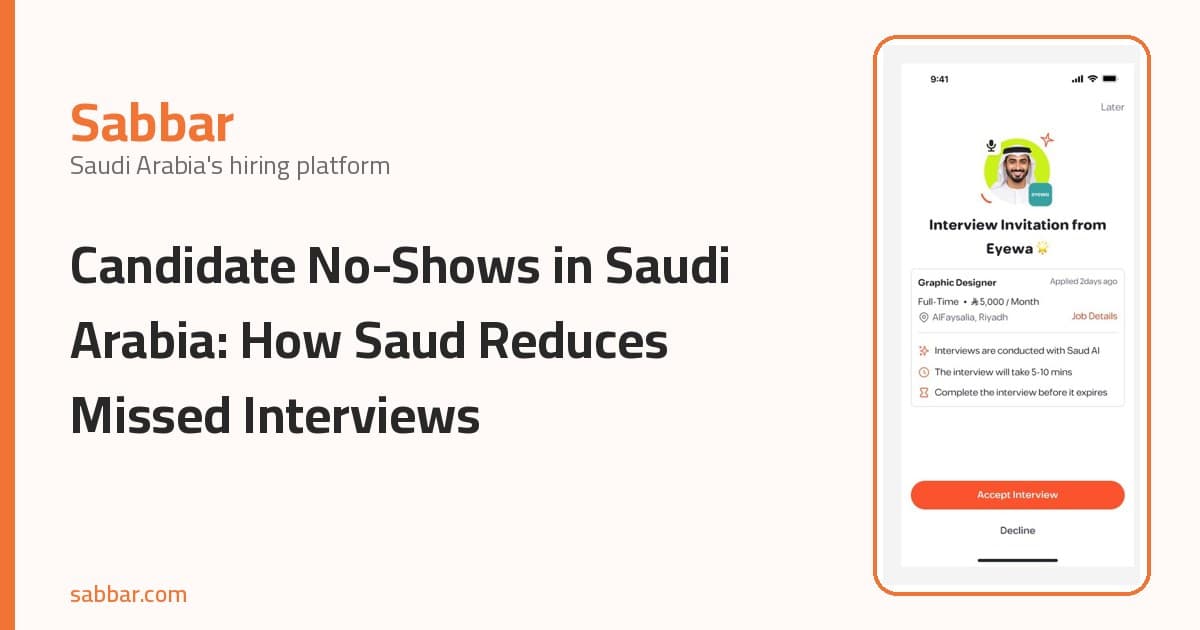
Saud offers the times you set, and the candidate picks one. People keep appointments they chose themselves.
A reminder before the slot
Saud follows up before the interview and reminds the candidate, on WhatsApp, the app they actually read.
An easy way to cancel
The candidate can reply in the same chat if plans change, so you find out early and fill the slot.
How many interviews did you lose this month? Book a Saud demo and see how pre-interview follow-up works.

Sabbar is Saudi Arabia's leading local hiring platform
The go-to place for job seekers and employers across every sector in the Kingdom, with more than 1.5 million job seekers and thousands of companies
Get started with Sabbar today!
How does Sabbar's data help reduce no-shows?
Sabbar's data addresses two main causes: distance and missing information.
- Distance: matching takes into account how close the applicant lives to the workplace, and job seekers see a warning when applying far from home.
- Nearest branch: for multi-branch jobs, job seekers see the branch closest to them.
- Salary and contract: shown in the post, so there are no surprises.
- Chat: a direct channel for sending the location and details.
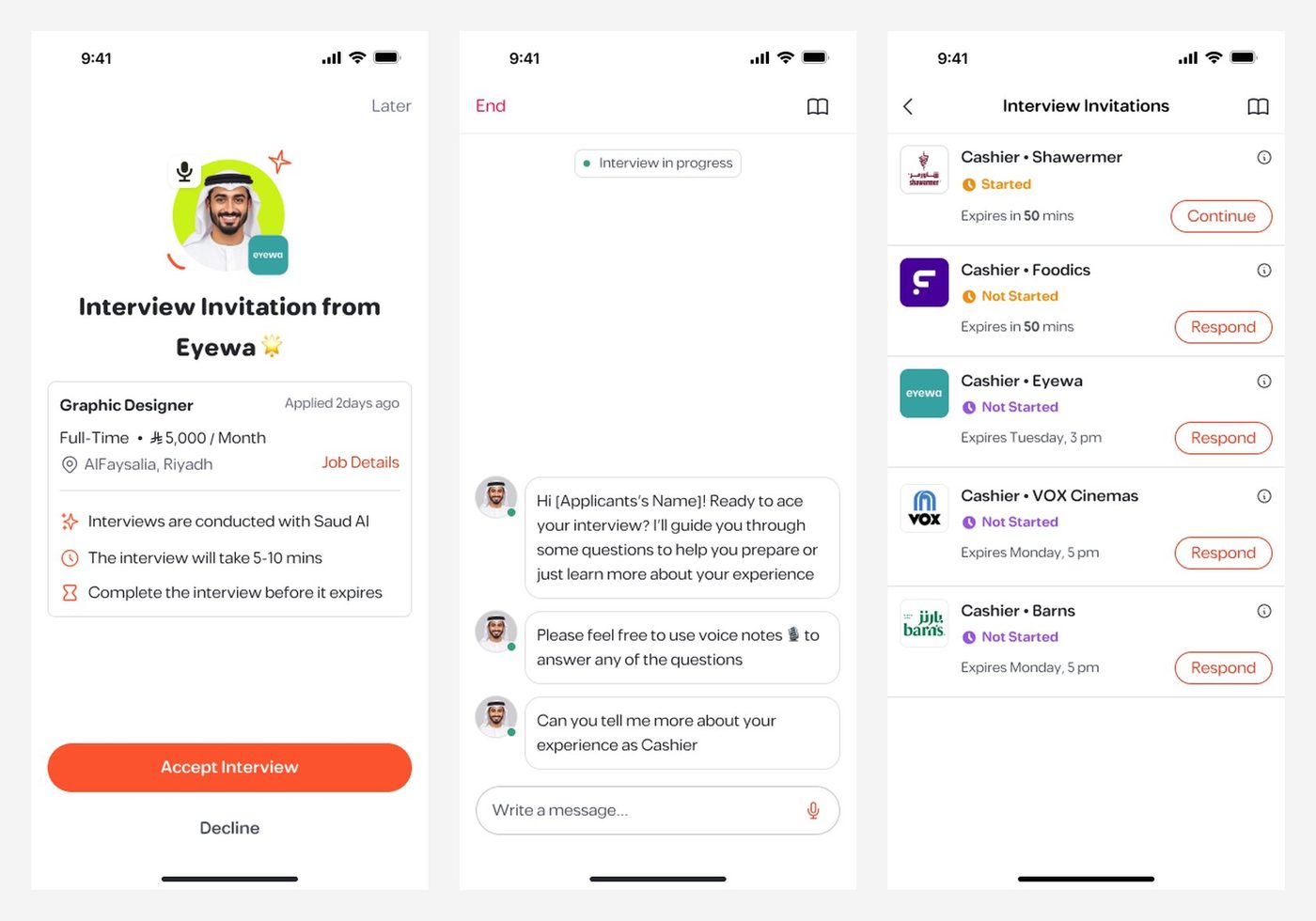
10 practical steps that raise attendance
You can apply these ten steps today, with or without Saud.
- Set the interview within 48 to 72 hours.
- Offer more than one time: morning and evening.
- Send a map link to the location.
- Give the interviewer's name and a contact number.
- State the length and what to bring.
- Share salary and shifts before the interview.
- Remind the day before and on the morning.
- Ask for a short confirmation reply.
- Make rescheduling easy: "if the time does not suit, tell us and we will change it".
- Start on time: a candidate kept waiting an hour tells others.
What should you do when a candidate does not show?
When a candidate does not show, respond calmly and systematically.
- Send a short message asking whether they want another slot.
- If there is no reply within a day, mark them "Not a match".
- Invite the next person on the shortlist straight away.
- Note the reason if you learn it, and adjust your process.
This is why a margin on the shortlist matters: three to five people per opening. See Candidate shortlisting with AI.
Are no-shows higher for certain jobs?
Yes. No-shows are higher for jobs that attract many applicants without strict experience requirements, such as cashiers, floor staff and sales associates. Applicants there apply to several jobs the same day and go with whoever contacts them first.
The answer is speed: whoever reaches out first and sets a near date wins the candidate. Automated coordination is covered in Automated interview scheduling with Saud.
Want better attendance in your next hiring campaign? See Saud for employers and let him follow up with candidates until interview day.
An illustrative example: the same interview handled two ways
This is an illustration, not a real customer case. A restaurant in Madinah wants to interview six candidates for a cashier role.
The first way: the manager phones each candidate on Sunday and agrees on the following Thursday. No location is sent and nobody is reminded. On Thursday only some of them turn up, and the rest do not answer the phone.
The second way:
- Each candidate picks a time from open slots within two days of being contacted.
- A message arrives with the map link, the manager's name, the length of the interview and what to bring.
- A reminder arrives before the appointment, asking them to confirm.
- Anyone who cannot make it declines or asks to change by message, and the slot goes to a reserve candidate.
In the second way one or two may still drop out, but the manager knows in advance and fills the slot. A surprise no-show becomes a known cancellation, and that is the real difference.
Ready wording for confirmation and reminder messages
Clear wording raises the reply rate. Here are three short messages you can use in Sabbar chat.
- Confirming the appointment: "Your interview for the cashier role is set for Tuesday at 5 pm at the Quba branch. It takes half an hour. Here is the map link. The branch manager will meet you."
- The day before: "A reminder of your interview tomorrow at 5 pm. Please confirm by replying (attending). If the time does not suit you, tell us and we will change it."
- After a no-show: "We waited for you at today's interview. If something came up and you are still interested, let us know today so we can set another time."
Each message carries specific information and one clear request.
How to calculate and track your no-show rate
What is not measured does not improve. The sum is simple: people who did not attend divided by confirmed appointments, per month and per branch.
- Split it by job: the rate for one role can be double another's, usually because of salary or shift.
- Split it by lead time: compare interviews booked within two days with those booked a week out.
- Split it by branch: a distant or hard-to-reach branch raises no-shows.
- Record the reason when known: another offer, distance, or forgetting.
After two months you will know where the problem concentrates, and can treat the actual cause rather than applying the same measures everywhere.
Day-one no-shows: how to prevent them
No-shows do not stop at the interview. Some accepted candidates do not turn up on their first day, which costs more.
- Shorten the gap between offer and start: the longer it is, the more likely another offer is accepted.
- Send the offer in writing: with the salary, shift and start date.
- Stay in touch: a message two days before the start asking whether they need anything.
- Prepare day one: who will meet them, where to go, and when the day ends.
- Keep a reserve candidate: do not close the job until the employee has actually started.
Cut missed interviews and let Saud follow up with candidates
Saud checks the candidate's commitment in the first interview, agrees a time that suits them and reminds them before they come. Book a demo and raise attendance at your interviews.
Summary
A candidate no show usually comes from a distant date, missing information or no reminder. Saud by Sabbar deals with these through the first interview, a slot the candidate chooses, and a reminder beforehand. Add a clear location and a near date and you will notice the difference.
FAQs about candidate no-shows
Does Saud remind the candidate before the interview?
Yes. Pre-interview follow-up is one of Saud's core jobs.
Does Saud guarantee every candidate attends?
Nothing guarantees that, but reminders, near dates and an early commitment check reduce no-shows.
What is the best gap between agreeing and interviewing?
Two to three days. The longer the gap, the higher the chance of a no-show.
How many candidates should I invite per opening?
Three to five on the shortlist, with a larger margin for frontline roles.
Should I contact a no-show again?
One message is enough. If there is no reply, move to the next candidate.