Automated Interview Scheduling in Saudi Arabia: How Saud Books Candidates Around Your Calendar 2027


Interview scheduling looks like a small task, yet it eats hours: a message to the candidate, waiting for a reply, a time that does not work, another suggestion, then a reminder before the day. Multiply that by twenty candidates and your week is gone.
Saud, Sabbar's AI hiring assistant, takes over the coordination. You set the available times, and he agrees slots with candidates and follows up until interview day.
What you will learn
- Why manual interview scheduling stalls.
- How Saud coordinates slots, step by step.
- The slot management tools on the Sabbar employer platform.
- Tips for choosing interview times candidates actually attend.
What is automated interview scheduling?
Automated interview scheduling means a system agrees the interview time with the candidate inside availability the employer set in advance, instead of manual back-and-forth with each person.
On Sabbar, Saud does this. He offers the candidate the available slots, confirms the choice, and reminds them before the time. Scheduling is one of Saud's four main jobs, all covered in Saud by Sabbar: the AI recruiter guide.
Why does manual scheduling stall?
Manual scheduling stalls because every slot takes several messages between two busy people.
- Candidates do not answer calls: especially from unknown numbers.
- Clashing hours: the candidate works or studies when you are free.
- Last-minute changes: one moved slot moves the rest.
- Forgetting: a time agreed a week ago with no reminder.
- Multiple branches: each branch manager has different hours.
How does Saud coordinate slots with candidates?
Saud coordinates slots in five steps.
- You set your availability: the days and hours you can interview.
- Saud contacts the candidate: on WhatsApp, the app candidates actually answer.
- The candidate picks a slot: from the times you made available.
- The slot is confirmed: and appears in your list of scheduled interviews.
- Saud follows up before the time: reminding the candidate and confirming attendance.
You stay out of the coordination entirely and find your calendar ready.
Watch your interview calendar fill without a single call. Book a Saud demo and learn how availability is set up for your team.

Sabbar is Saudi Arabia's leading local hiring platform
The go-to place for job seekers and employers across every sector in the Kingdom, with more than 1.5 million job seekers and thousands of companies
Get started with Sabbar today!
What slot management tools does the platform offer?
The slot management tools are part of the Enterprise plan on the Sabbar employer platform. There are two.
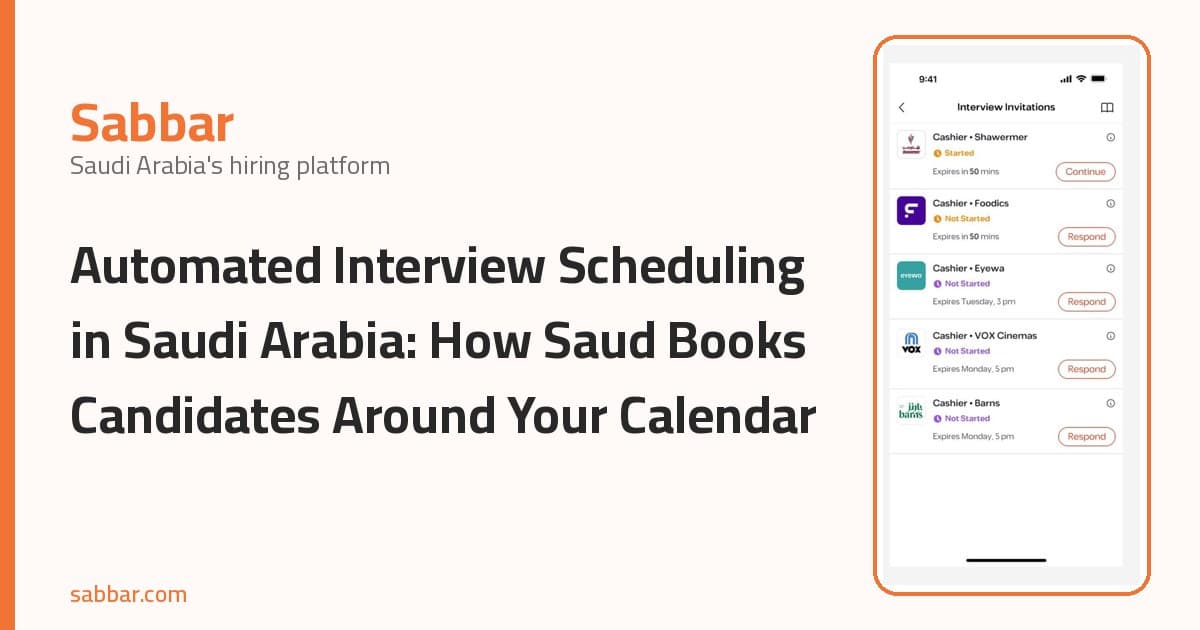
Scheduled Interviews
A list of all upcoming interviews with filters, so you can see interviews for one job, one branch or one day.
Interview Appointments
Where you define available slots. You add days and hours, and Saud offers them to candidates.
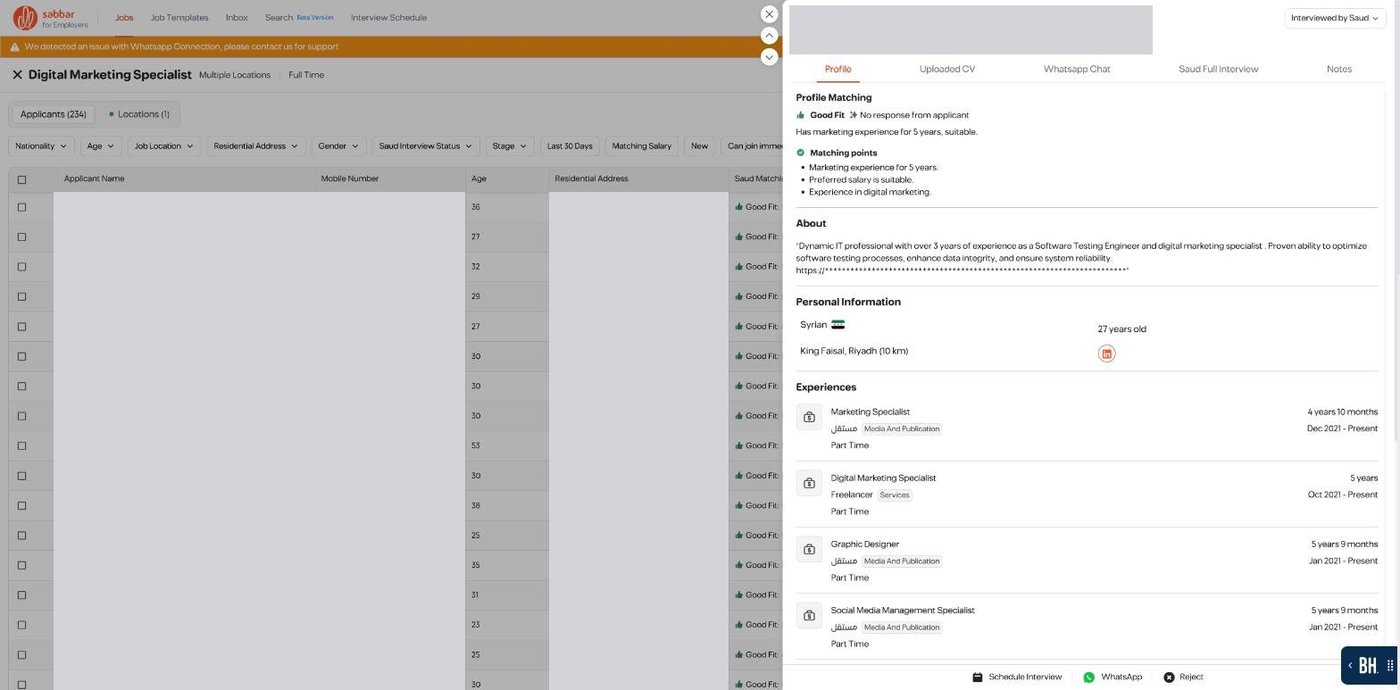
From any applicant's profile on the platform there is also a Schedule Interview action, next to WhatsApp and Reject.
How does scheduling connect to the rest of Saud's work?
Scheduling is one link in a chain that starts with the application and ends with the final interview.
- Screening: Saud rates applicants Good Fit or Close Fit.
- First interview: he interviews them on WhatsApp and writes his notes.
- Scheduling: he books the in-person interview with the people you chose.
- Follow-up: he reminds the candidate before the time.
Each link has its own article, such as AI interviews on WhatsApp and candidate shortlisting with AI.
7 tips for slots candidates attend
Choosing the right times is half the solution. Seven tips from hiring in Saudi Arabia:
- Keep it close: an interview in two or three days beats one in two weeks.
- Offer evening slots: many candidates work or study in the morning.
- Avoid prayer times and rush hour: and allow for travel time in big cities.
- Plan for Ramadan: after Taraweeh works better than late afternoon.
- Group interviews on one day per branch: easier for the branch manager.
- Send the exact location: a map link and the name of the interviewer.
- State the length and what to bring: half an hour, and an ID, for example.
What should you prepare before the interview?
Before the interview you already have material from Saud that shortens your preparation.
- Read Saud Notes and the matching points.
- Pick two questions from the unmatched points.
- Watch the introductory video if there is one.
- Agree with the branch manager who makes the final call.
What if the candidate wants to change the time?
If the candidate wants a different time, the conversation stays in the same chat and another slot is chosen from what is available. Keep your availability current so no outdated slot is offered.
Many branches, each with its own hours? Talk to the Saud team about setting slots per location.
An illustrative example: a week of interviews, scheduled by hand and by Saud
This illustrates the workflow; it is not a real customer case. A retailer in Riyadh wants to interview twelve candidates for a sales associate role across three branches.
Scheduled by hand: the recruiter phones each candidate. Some do not pick up the first time, some ask for another time, and then the recruiter checks with branch managers that they are free. Coordination stretches over days, and nobody reminds candidates before the appointment.
With Saud:
- Each branch manager sets the available slots once.
- Saud contacts candidates on WhatsApp, and each one picks a time from the open slots.
- Confirmed appointments appear in the Scheduled Interviews list.
- Saud follows up with each candidate before the appointment.
The recruiter opens the list to find the week's interviews ready, and spends the time preparing for the interviews themselves.
How to choose your available interview slots
The slots you open decide who turns up. Follow these rules when you set them.
- Open slots on more than one day: two different days in a week cover most candidates' circumstances.
- Keep slot length realistic: half an hour is usually enough for frontline roles, with a gap between interviews.
- Do not open more than you can honour: cancelling from your side leaves a bad impression.
- Use the right branch: hold the interview at the branch where the candidate will work. It is a practical test of the commute.
- Refresh slots weekly: holidays and seasons change branch managers' availability.
What to do when a candidate does not show up
No-shows happen even with the best coordination. What matters is having a clear routine.
- Wait fifteen minutes, then message: a short note in Sabbar chat asking whether they are on the way.
- Offer one alternative time: emergencies happen, and one second chance is enough.
- Record it: move the candidate to the right stage with a note, so colleagues know what happened.
- Go to your reserve: contact the next candidate on your shortlist the same day.
Repeated no-shows for one job are a signal worth reviewing: the interview may be too far from the application date, the branch location unclear, or the salary missing.
How to measure whether scheduling works
Four simple numbers show whether scheduling is working for you.
- Days from selection to interview: how long it takes from moving a candidate to Shortlisted to the appointment.
- Attendance rate: how many confirmed candidates actually came.
- Rescheduling rate: a high figure means your slots do not suit candidates.
- Team time on coordination: the hours spent on calls before and after.
Common interview scheduling mistakes
- A distant date: an interview ten days away means the candidate accepts another offer first.
- Morning slots only: this excludes anyone currently working or studying.
- No location sent: the district name is not enough. Send the map link.
- An unprepared interviewer: a branch manager who has not read the candidate's summary wastes both sides' time.
- No outcome shared: one message after the interview protects your reputation with job seekers.
Let Saud coordinate the slots while you focus on the interview
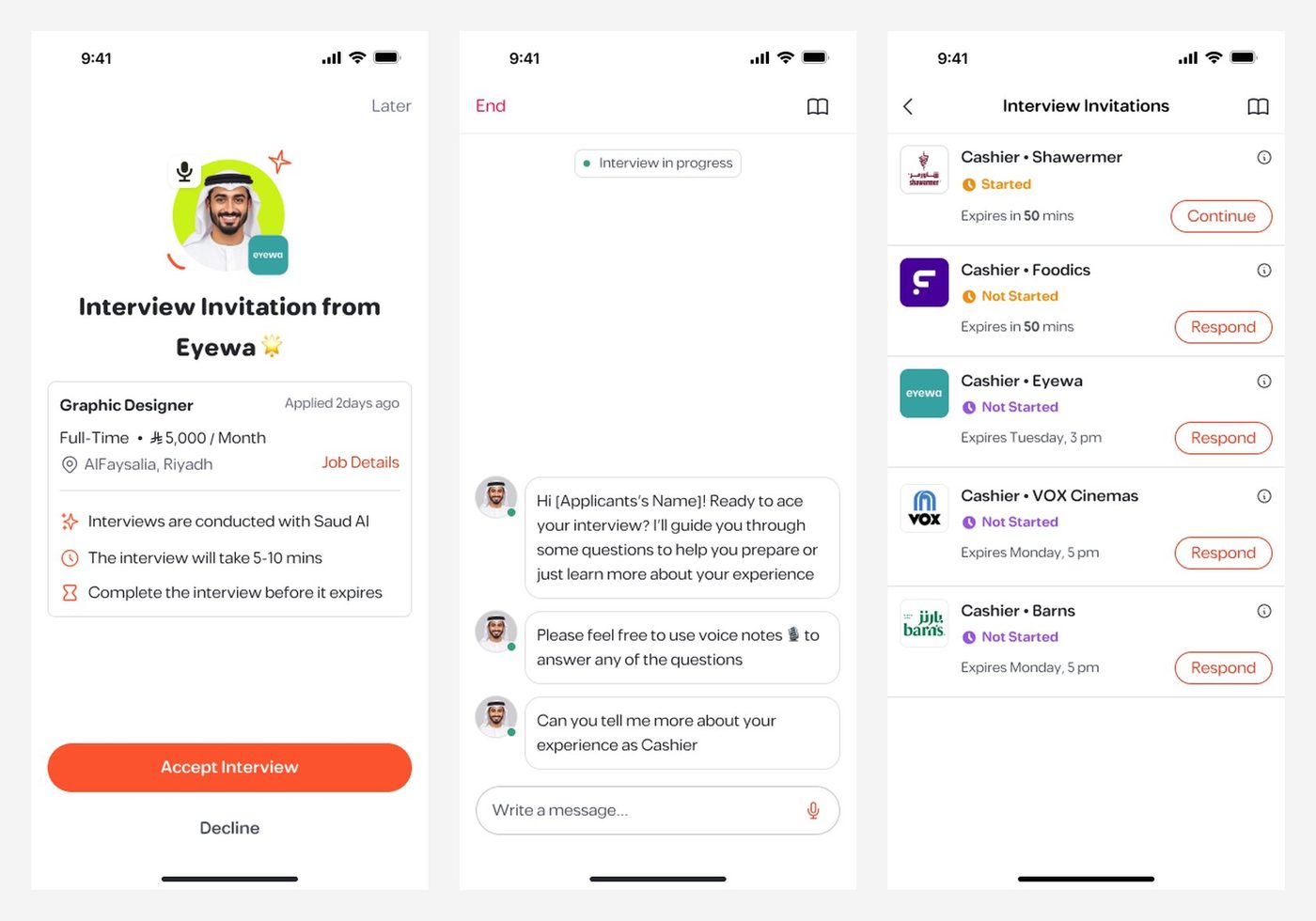
Set your availability once, and Saud agrees times with candidates on WhatsApp and reminds them beforehand. Book a demo and watch your interview calendar fill without the back-and-forth.
Summary
Interview scheduling with Saud turns repeated messaging into an automated step: you set availability, the candidate chooses, and Saud confirms and reminds. The result is a clear calendar, better attendance and more time for the interview itself.
FAQs about interview scheduling with Saud
Does Saud schedule around my availability?
Yes. Saud offers candidates only the times you define.
Where do I see scheduled interviews?
In Scheduled Interviews on the Sabbar employer platform, with filters by job and branch.
Does Saud remind the candidate beforehand?
Yes. Pre-interview follow-up is one of Saud's jobs, and it is there to reduce no-shows.
Is scheduling available in every plan?
Interview scheduling and slot management are part of the Enterprise plan.
Can I schedule an interview manually?
Yes. The applicant's profile has a Schedule Interview action, and you can also reach them by chat.