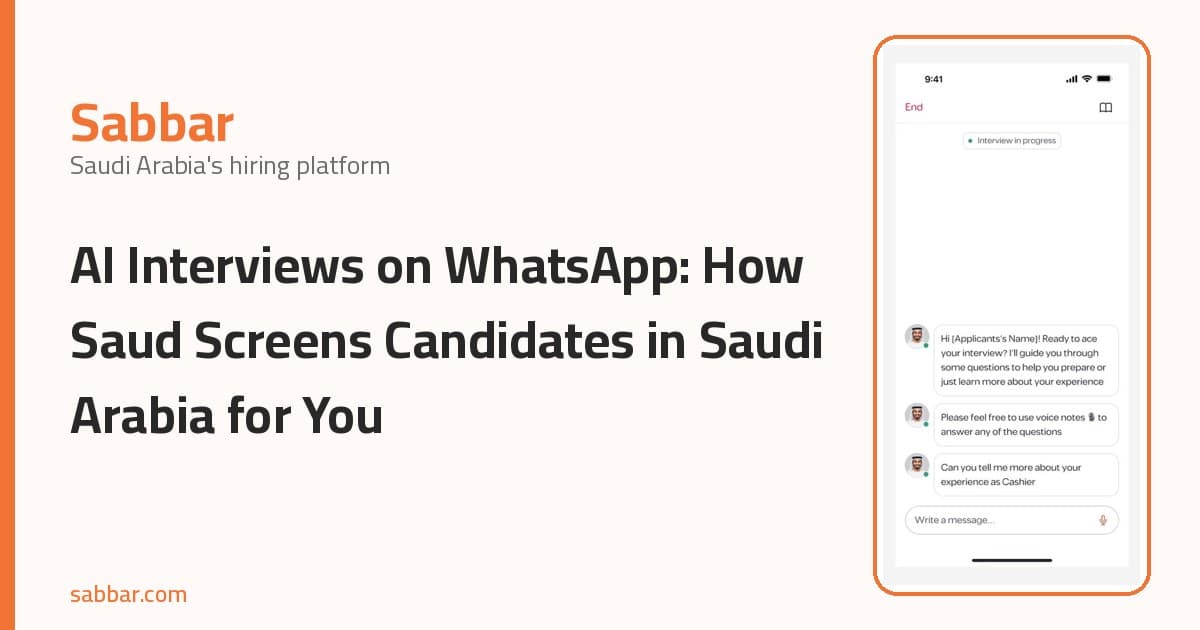
An AI interview sounds futuristic until you see where it happens: inside WhatsApp, the app people in Saudi Arabia actually answer. Saud, Sabbar's AI hiring assistant, runs the first interview with candidates there on your behalf.
This article explains how the first interview on WhatsApp works, what Saud asks, how the summary reaches you, and when you step in.
What you will learn
- Why a first interview on WhatsApp suits the Saudi job market.
- The stages of the interview, from invitation to summary.
- What you receive after each interview.
- How to prepare your job so the interviews are useful.
What is an AI interview with Saud?
An AI interview with Saud is a first interview held inside a WhatsApp conversation with an AI assistant, instead of a phone call with a recruiter. The applicant answers by text or voice note, and Saud records and analyses the answers.
A first interview is a short one that checks the basics: experience, availability, and fit with the job's conditions. It is not the final decision interview; that stays with you. For a full introduction, read Saud by Sabbar: the AI recruiter guide.
Why WhatsApp?
WhatsApp works because it is the channel candidates use every day and reply to quickly. Four practical reasons:
- Candidates ignore unknown numbers: many job seekers do not pick up calls from numbers they do not recognise.
- No appointment needed: the candidate answers when it suits them, even after a shift.
- Voice shows more than text: a voice note gives a sense of how the person speaks.
- Nothing new to install: the chat happens in an app already on the phone.
How does the first interview on WhatsApp work?
The interview runs in four stages, with no action needed from you.
1. The interview invitation
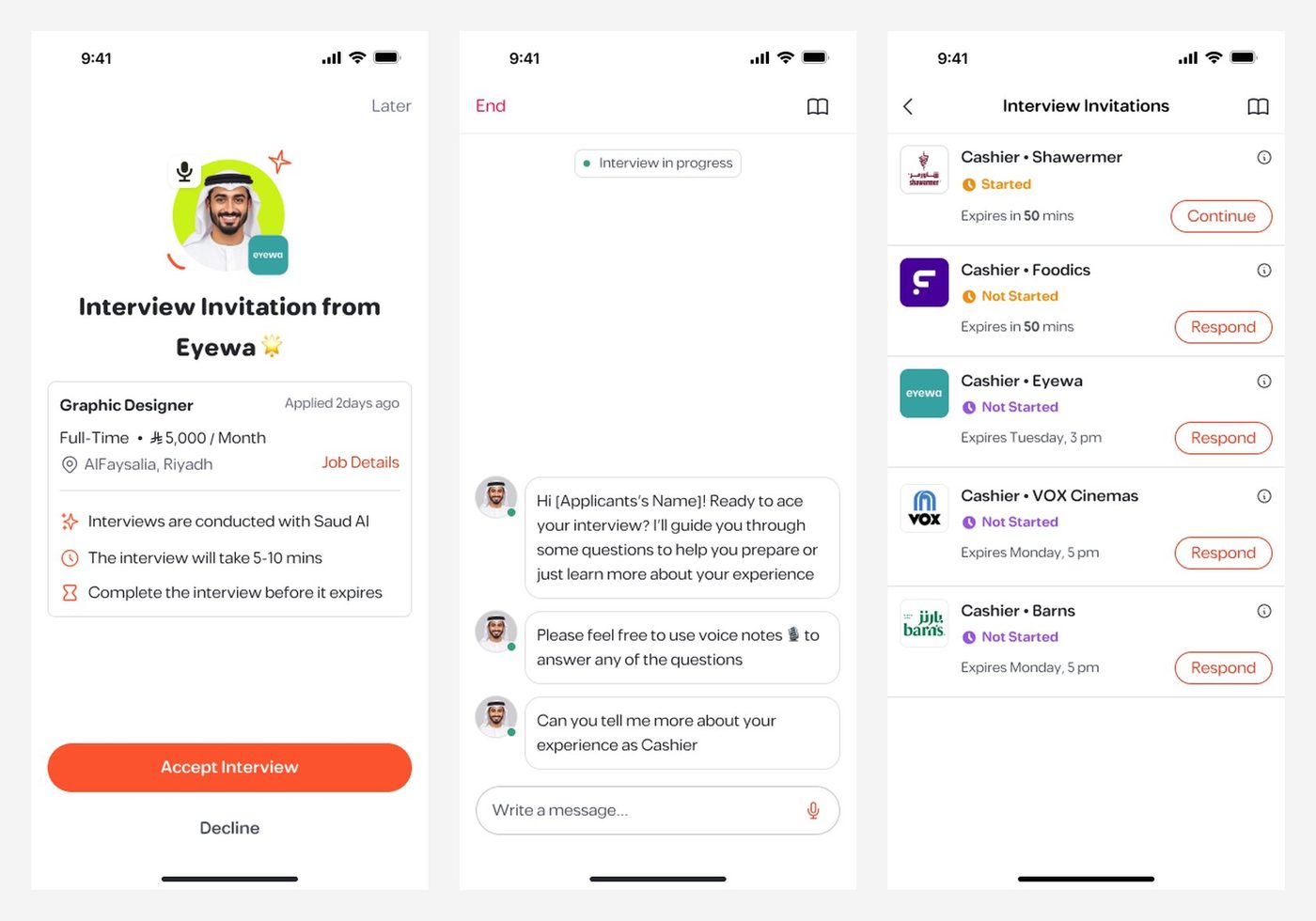
After an applicant applies to your job, they receive an interview invitation from Saud in your company's name. The invitation also appears in the Sabbar app, with three facts: it is with Saud, it is short, and it expires.
2. Accepting and starting
The applicant accepts, declines or postpones. On accepting, Saud welcomes them and explains how to answer.
3. Questions and answers
Saud asks about the applicant's experience and what matters for the job, and takes answers by text or voice. An applicant who drops off midway can come back and resume where they left off.
4. Summary and rating
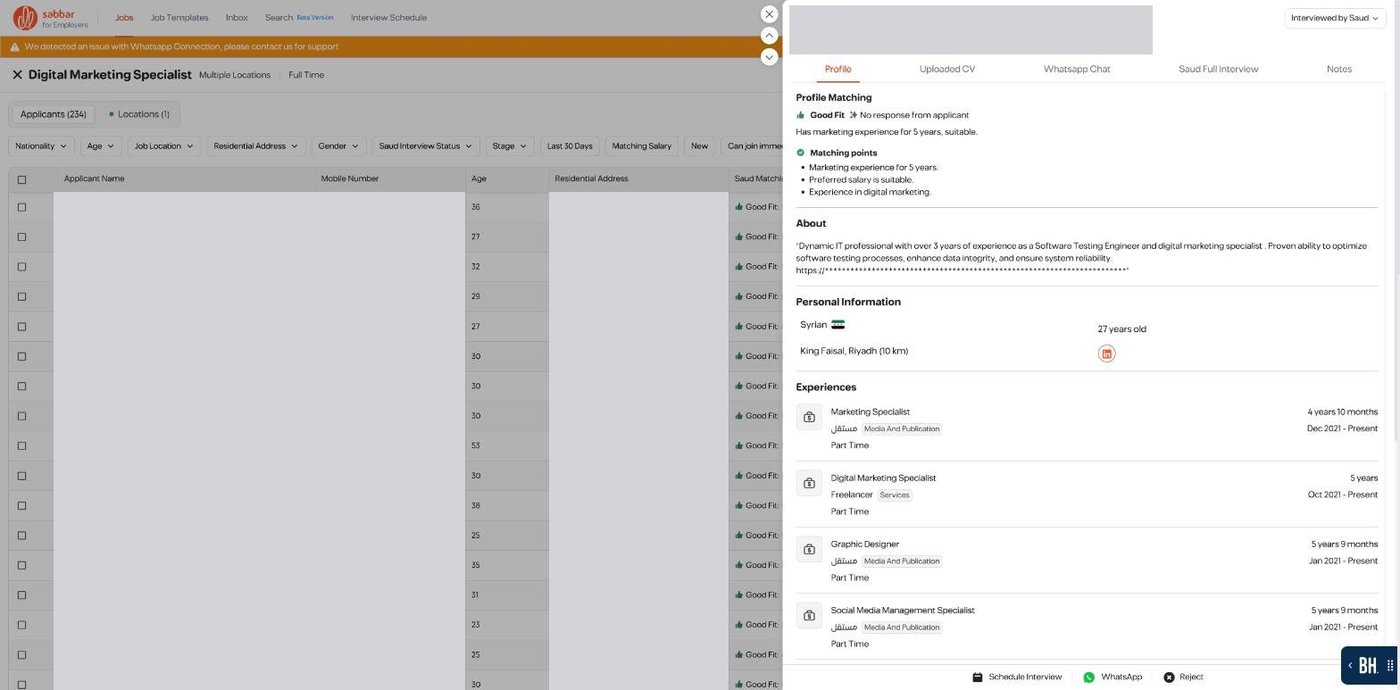
When the interview ends, Saud prepares his assessment, and it appears on the applicant's profile in your company account.
Want to see a real interview from start to finish? Book a Saud demo and we will show you the conversation and the summary as your team would receive them.

Sabbar is Saudi Arabia's leading local hiring platform
The go-to place for job seekers and employers across every sector in the Kingdom, with more than 1.5 million job seekers and thousands of companies
Get started with Sabbar today!
What do you receive after the interview?
After each interview you receive three things on the applicant's profile.
- A fit verdict: Good Fit, Close Fit or Not Fit.
- Saud Notes: a short summary, matching points and unmatched points.
- The full transcript: every question and answer, under "View Full Interview".
You decide in a minute who deserves your in-person interview, instead of spending a quarter of an hour on a call with each applicant.
How do you prepare your job for useful interviews?
You prepare your job by writing clear requirements, because Saud builds his questions and rating on them.
- Pick the right title from the list.
- Enter required experience and language level in the requirement fields.
- Set the work location and shifts precisely.
- Enter the real salary, even if you hide it from the post.
- Review the first batch of summaries and adjust the requirements if needed.
On the Enterprise plan you can configure "Auto interviews": Saud automatically interviews applicants who meet criteria you define, using your own questions.
When does the recruiter step in?
The recruiter steps in after the first interview, at the shortlist. Saud handles the repetitive stage; you keep the decision.
- Review the Good Fit applicants first.
- Move the right ones to the Shortlisted stage.
- Run the in-person interview or a trial shift.
- Make the hire.
Saud AI Interviews are included in the Premium and Premium Plus plans, and an interview is counted only when it actually happens. If the applicant does not complete it, it is not deducted.
Is your team losing hours to first calls that end in "not suitable"? See Saud for employers and hand those calls to him.
Does a WhatsApp interview suit every job?
A WhatsApp interview suits jobs that attract many applicants, and those benefit the most.
- Frontline roles: cashier, barista, sales associate, customer service.
- Seasonal hiring: seasons, events and branch openings.
- Multi-branch hiring: the same role in several cities.
For leadership and specialist roles, the first interview still helps as an early screen, but the in-person interview carries more weight. Once people are hired, a clear plan for onboarding and training retail and F&B staff keeps them.
First-interview questions that work for frontline roles
A good first interview asks about the things that decide whether someone stays, not what is already on the CV. These are the question types worth reflecting in your requirements so Saud builds the interview on them.
- Availability: when can the applicant start, and are they tied to another job?
- Shifts: do evenings, weekends and peak seasons suit them?
- Getting to the site: how will they reach the branch, and how far do they live?
- Hands-on experience: what exactly did they do in the last role, and on which system?
- A real situation: how did they deal with an angry customer or a rush-hour queue?
- Expectations: do the advertised salary and hours work for them?
In the Enterprise plan you can write your own questions for Saud to ask, which helps when your company has specific conditions such as a health certificate or a driving licence.
How to read a Saud summary in one minute
Reading every summary in the same order saves time and keeps your decisions consistent across candidates.
- Start with the verdict: Good Fit first, then Close Fit.
- Read the unmatched points before the strengths: they tell you whether the gap can be covered.
- Open the transcript only when in doubt: if the reason is unclear, read the applicant's own answer.
- Act immediately: move the right people to Shortlisted and message them, and reject the rest so the list does not pile up.
A practical rule: never leave a Good Fit without a reply for more than a day, because they have usually applied elsewhere too.
An illustrative example: the same job with and without Saud
This illustrates the workflow; the scenario is not taken from a real customer. A café chain is opening a new branch in Dammam and needs several staff.
Without Saud: the recruiter phones applicants one by one. Some do not answer, some answer and turn out not to want the shift, and the calls stretch over days.
With Saud: every applicant receives the interview invitation after applying and answers when it suits them. In the morning the recruiter opens a ranked list: Good Fits with a summary each, and Close Fits with the reason for the gap. The day starts with contacting the Good Fits directly.
The difference is not who decides, because the decision is yours in both cases. The difference is that your time goes to people who have already passed the basics.
Mistakes that reduce the value of the first interview
These mistakes are common in a company's first weeks, and they are easy to avoid.
- Vague requirements: if you do not set the shift and experience, Saud will not ask about what matters to you.
- Slow contact with Good Fits: a ready summary loses its value if the candidate waits for days.
- Treating the rating as final: a Close Fit can be an excellent hire with a little training.
- Not telling the candidate what comes next: a short message after the interview, booking a time or declining politely, protects your reputation.
- Never opening a transcript: reading two or three interviews at the start gives you confidence in how the assessment works.
Hand the first interview to Saud and get a ready summary for every candidate
Saud interviews applicants to your jobs on WhatsApp at a time that suits them, then gives you the fit verdict, his notes and the transcript. Book a demo and see how it works on your own roles.
Summary
An AI interview on WhatsApp with Saud moves the first interview from tiring phone calls to a chat the candidate answers in their own time. You receive a verdict, notes and a full transcript, and start directly from the shortlist.
FAQs about Saud's WhatsApp interview
Does the applicant know they are talking to AI?
Yes. The invitation states that the interview is conducted with Saud, the AI assistant, on behalf of your company.
Can the applicant answer by voice?
Yes. The interview accepts both text answers and voice notes.
What if the applicant does not finish the interview?
The applicant can return and resume before it expires. An interview is only counted for the company when it actually takes place.
Can I read the whole interview?
Yes. The full transcript is on the applicant's profile, next to Saud Notes.
Can I connect my company's WhatsApp number?
Connecting a WhatsApp Business number with a shared inbox is part of the Enterprise toolset.