Resume screening is the stage that eats most of a recruiter's week. A single post for a cashier or customer service role in Riyadh can bring hundreds of applicants in days, and reading every CV by hand slows hiring and buries the good candidate in the pile.
Saud, Sabbar's AI hiring assistant, takes over that screening. This article explains how Saud rates applicants, what you see afterwards, and how to use the result in your decision.
What you will learn
- What AI resume screening is and how it differs from manual screening.
- The criteria Saud uses to rate an applicant.
- What the result looks like: Good Fit, Close Fit and Not Fit.
- Practical steps to get sharper screening.
What is AI resume screening?
AI resume screening is an automated comparison between each applicant's data and the job's requirements, ending in a rating that shows how well they match. Unlike manual screening, every applicant is measured against the same criteria, in a short time.
On Sabbar, Saud does this screening. He reads the requirements you set in the job post, compares them with the applicant's Sabbar CV, and gives you a verdict with a reason. For a general introduction, read Saud by Sabbar: the AI recruiter guide.
Why does manual screening wear teams down?
Manual screening wears teams down because the volume of applications is larger than the time available. These are the most common problems for Saudi employers.
- Many unmatched applications: a share of applicants apply to every post without reading the requirements.
- Criteria that change by reader: each recruiter reads a CV in their own way.
- Slow replies: the good candidate accepts another offer before you reach their CV.
- Seasonal pressure: Ramadan, Eid and entertainment seasons raise demand suddenly.
High turnover makes it worse, because the same roles reopen again and again.
How does Saud pick the best candidates for your job?
Saud picks candidates by comparing the job's structured requirements with each applicant's data. The clearer your requirements, the sharper the screening.
The criteria Saud looks at
Saud relies on what you defined when you created the post. The main criteria are:
- Experience in the same role: whether the applicant has done similar work and for how long.
- Distance and district: how close the applicant lives to the workplace or branch.
- Skills: the skills you selected in the post against the applicant's skills.
- Language: English level, if you asked for it.
- Expected salary: how well it fits the salary on offer.
See the difference yourself: book a Saud demo and watch a long applicant list turn into a clear ranking by fit.

Sabbar is Saudi Arabia's leading local hiring platform
The go-to place for job seekers and employers across every sector in the Kingdom, with more than 1.5 million job seekers and thousands of companies
Get started with Sabbar today!
What do you see after screening?
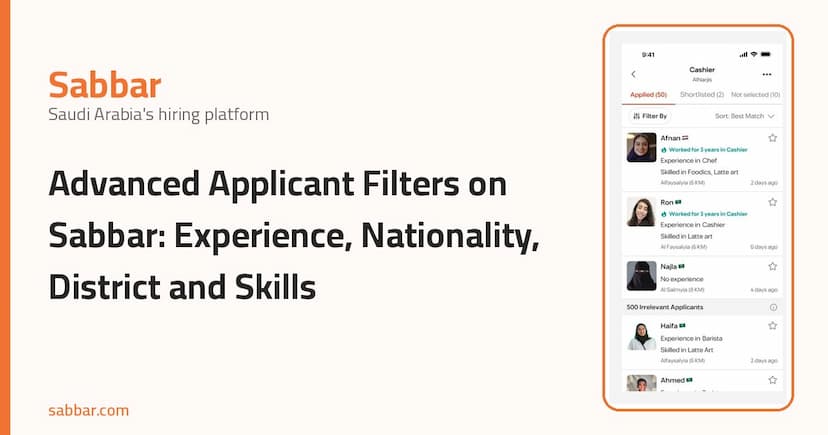
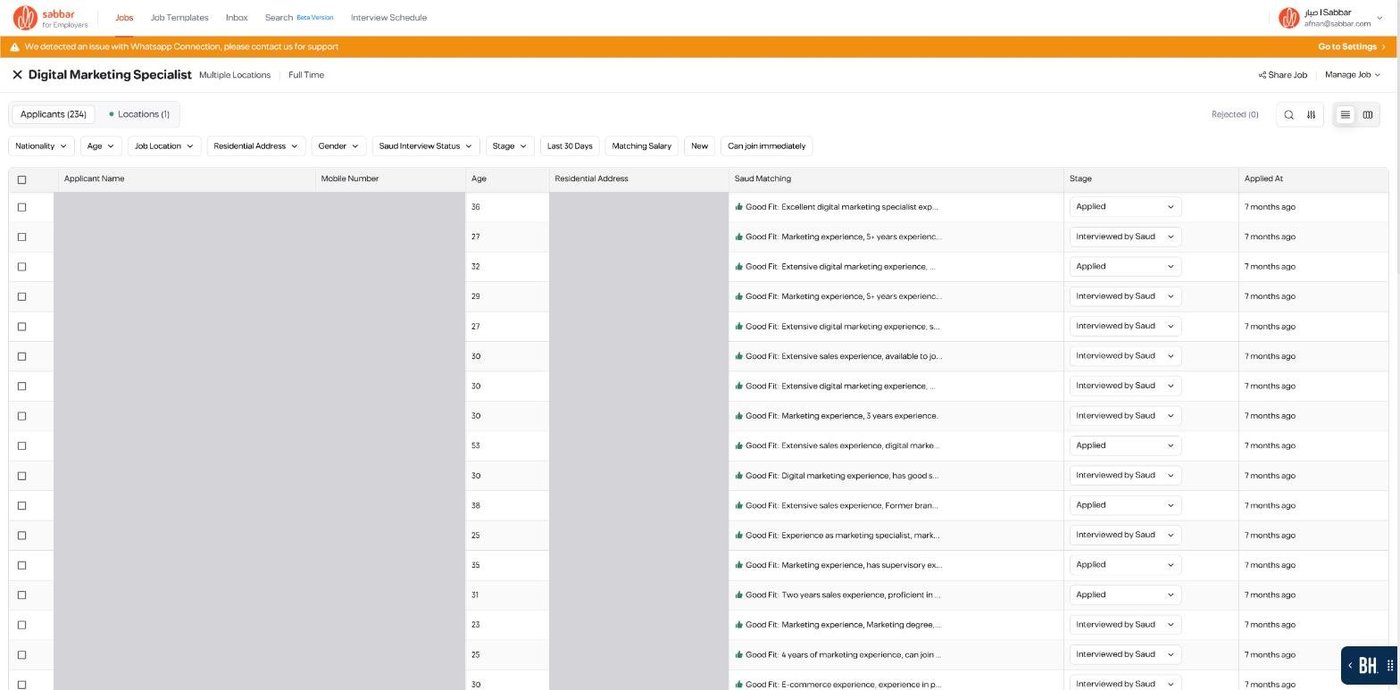
After screening, each applicant shows a fit rating and a one-line reason. The ratings are:
- Good Fit: the applicant meets the job's core requirements.
- Close Fit: the applicant meets most requirements and misses one or two.
- Not Fit: appears after a Saud interview if the applicant turns out not to suit the job.
The short reason explains why the applicant got that rating, such as relevant experience or a short commute. You understand the verdict instead of trusting an opaque score.
From screening to the first interview
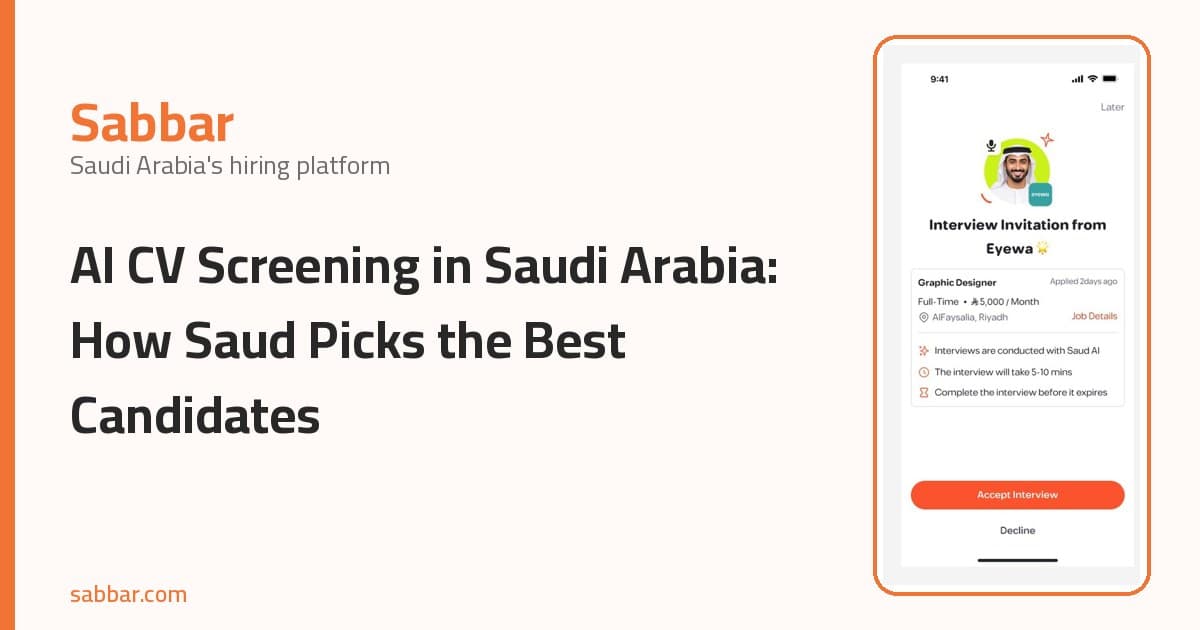
Screening is not where Saud stops. In the Premium and Premium Plus plans, Saud runs a first interview with applicants on WhatsApp, by text or voice. Afterwards the applicant's profile shows "Saud Notes": a summary, matching points and unmatched points, with the full interview transcript.
How do you get sharper screening?
You get sharper screening by writing a clear, specific job post. Here are five practical steps.
- Pick the job title from the list: the right title attracts the right applicants from the start.
- Put requirements in their fields: experience, skills and language belong in the requirement fields, not only in the description.
- Enter the real salary: a clear salary reduces drop-outs later, and you can hide it and use it for matching only.
- Set the work location precisely: district matters for frontline roles because distance affects commitment.
- Use a structured description: "Write with Saud" drafts one from the job title in seconds.
If applications are arriving faster than your team can read them, see how Saud works for employers and let him set the priorities before your day starts.
Does AI screening replace the recruiter's decision?
No, AI screening does not replace the recruiter's decision. Saud ranks and explains; the final call stays with you.
- Saud saves time in the repetitive early stages.
- You review the shortlist and run the final interview.
- You can always open any applicant's profile and read the full CV, whatever the rating.
That split is the practical value of AI in HR: the machine handles repetition, and people keep the judgment.
An illustrative example: reading Saud's rating for three applicants
This is an illustration, not real data. The job: a cashier at a branch in Al Malqa, Riyadh, with at least one year of experience and a salary set in the post.
- Applicant one: two years as a cashier, lives in a nearby district, and expects a salary inside your range. Rated Good Fit, with relevant experience and a short commute as the reason.
- Applicant two: retail sales experience but no time on a point of sale, and lives further away. Rated Close Fit, and the reason names what is missing.
- Applicant three: no previous experience, but lives next to the branch and can start immediately. Also Close Fit, for a different reason.
The right way to read it: start with the Good Fits, then look at the reason behind each Close Fit. The second could succeed with short system training, and the third may be a strong option if your company trains beginners. The rating sets your priorities; it does not decide for you.
What to do with a Close Fit candidate
A Close Fit is not a rejection. It is a candidate who misses one or two things, and how you handle them decides how many good hires you keep.
- Read the reason first: is the gap in experience, distance, salary or language?
- Ask in chat: one direct question usually settles it, such as shift availability or how they would reach the branch.
- Decide what can be covered: a skill gap closes with training, while a long commute or a wide salary gap shows up later as absence or resignation.
- Do not leave it open: if the answer is no, move the applicant to Rejected so your list stays clean.
Mistakes that weaken the screening result
AI screening works on what you enter. These mistakes make the result less accurate, however good the system is.
- Inflated requirements: asking for five years of experience for an entry-level role turns most good applicants into Close Fits.
- An unrealistic salary: a figure below the market pushes most applicants out of the match on salary.
- One post for several roles: merging a cashier and a shift supervisor in one post confuses matching. Give each title its own post.
- Ignoring the reasons: reading the rating without the reason costs you candidates you could train.
- A stale post: if the salary or shift changes, edit the post, because screening compares against the current data.
How do you measure the effect of AI screening?
You measure it by comparing your numbers before and after Saud, on the same type of role. Four indicators are enough.
- Time to first contact: the hours between an application arriving and your first message to the candidate.
- Applicants per useful interview: how many applicants you review to reach one interview worth holding.
- Time to fill: the days from publishing the post to the hire.
- Retention at three months: did the hire stay? This one measures the quality of the choice, not its speed.
Record these for one month before the change and one month after, and you will see in numbers where screening saved your team time.
Let Saud screen applicants while you focus on the final interview
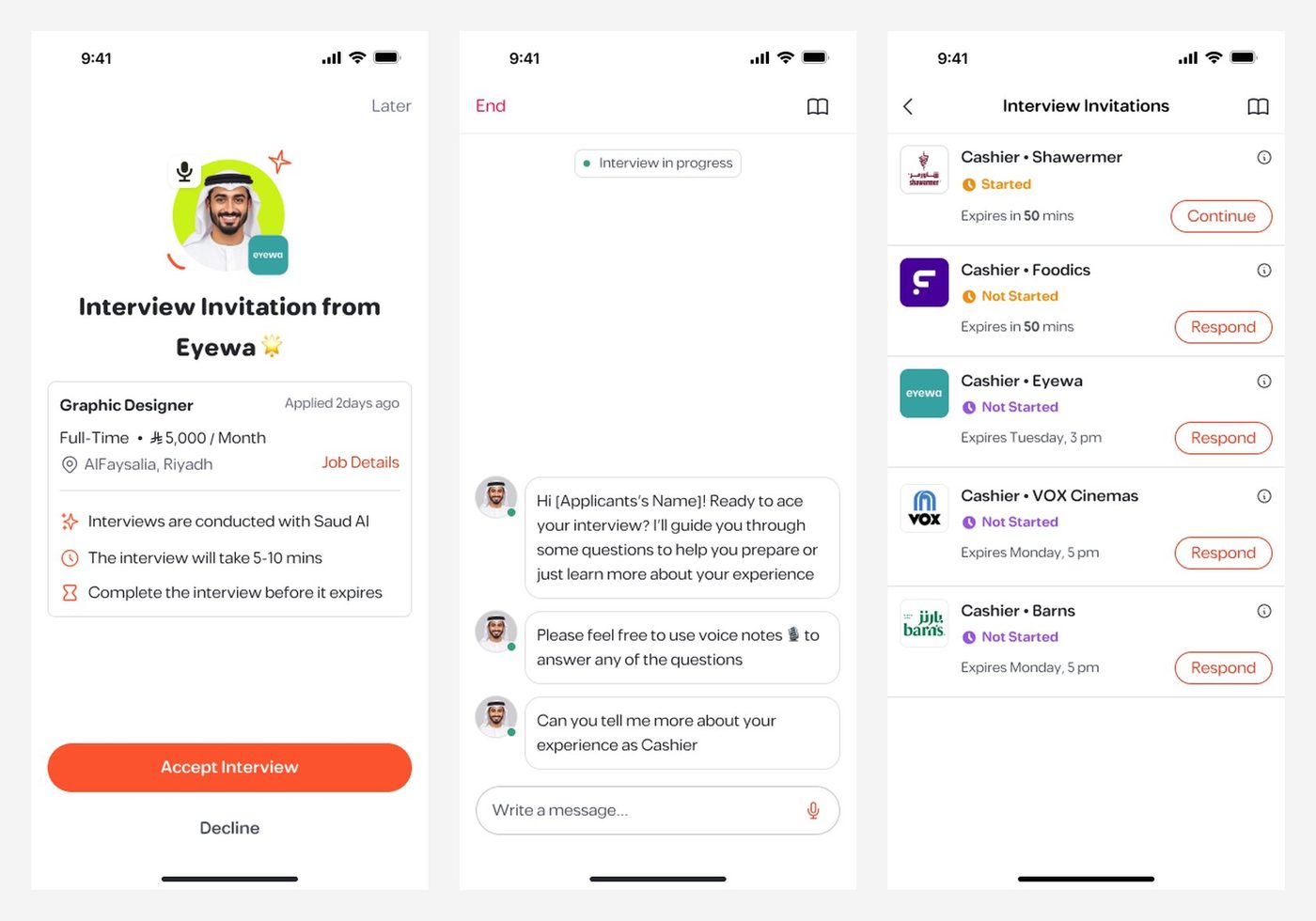
Saud rates every applicant to your job, marks them Good Fit or Close Fit with the reason, then interviews the right ones on WhatsApp and sends you the summary. Book a demo and see the result on your own roles.
Summary
AI resume screening turns hundreds of applications into a clear ranking in a short time. Saud by Sabbar compares each applicant with your job's requirements, gives a rating with a reason, and follows up with the first interview. The outcome is less time reading and a faster route to the right candidate.
FAQs about AI CV screening with Saud
Does Saud reject applicants automatically?
No. Saud rates applicants and explains why, and never removes anyone from your list. You can review any applicant and decide yourself.
How does Saud decide an applicant is a Good Fit?
Saud decides based on the requirements you entered in the post, such as experience, distance, skills and language, compared with the applicant's data.
Is screening available in every plan?
AI matching is included in every Sabbar plan. Saud AI Interviews come with Premium and Premium Plus.
Does AI screening suit frontline roles?
Yes, and it helps most there, because roles such as cashier, barista and customer service receive large numbers of applicants.
Do job seekers pay for a Saud interview?
No. Saud is completely free for job seekers. The cost sits in the employer's plan only.