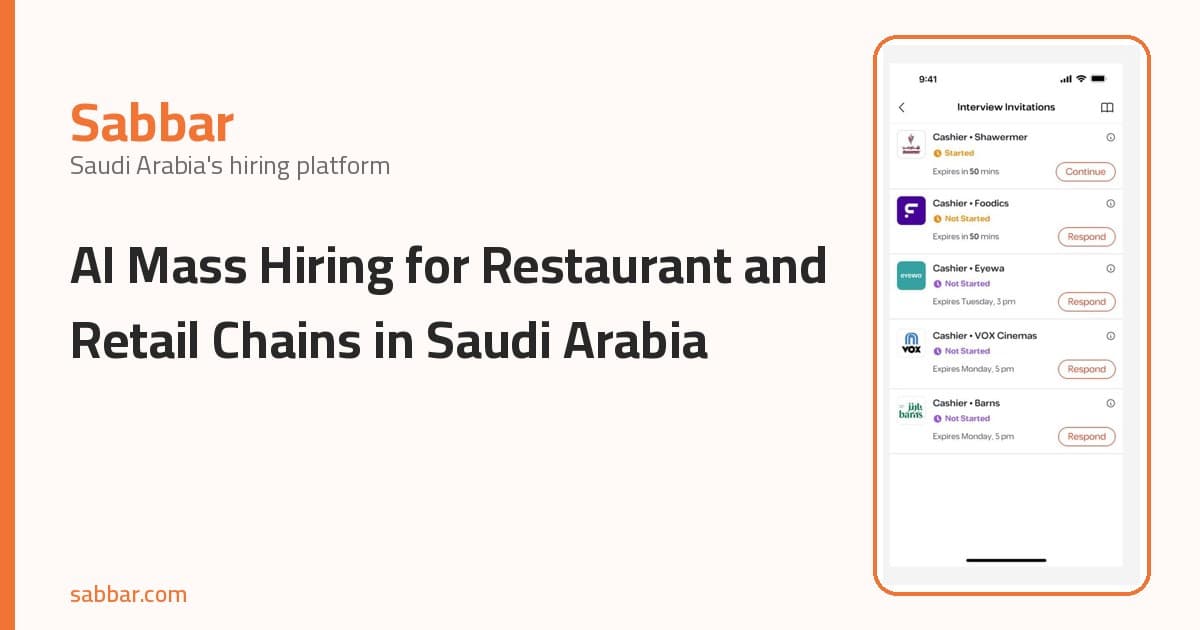
Mass hiring means filling many seats for the same roles in a short time. A restaurant chain opening five branches in Jeddah, or a retailer preparing for Ramadan, needs dozens of cashiers, baristas and sales associates within weeks.
Done the traditional way, that is thousands of CVs and hundreds of phone calls. With Saud, Sabbar's AI hiring assistant, those stages become an automated process that ends in a shortlist for each branch.
What you will learn
- What mass hiring is and why it is hard in restaurants and retail.
- How Saud runs screening and interviews at volume.
- Sabbar's tools for multi-branch hiring.
- A practical five-step plan for a mass hiring campaign.
What is AI mass hiring?
AI mass hiring is the use of an AI assistant to carry out the repetitive stages of high-volume recruitment: screening, the first interview and scheduling. The aim is to keep the hiring team small however many vacancies there are.
On Sabbar, Saud is that assistant. He works on a base of more than 1.5 million job seekers, many of them looking for frontline roles. For an introduction, read What Is Saud by Sabbar?.
Why is mass hiring hard in restaurants and retail?
Mass hiring is hard in these two sectors because volumes are high, time is short and turnover is steep.
- The same role in many places: each branch needs people who live nearby.
- Pressure seasons: Ramadan, Eid, back to school and entertainment seasons.
- Interview no-shows: a share of candidates never turn up.
- Saudization rules: many sales and outlet roles fall under localization decisions. This Tawteen checklist for malls and sales outlets covers the basics.
- Repeat resignations: the same vacancy opens more than once a year.
How does Saud run mass hiring?
Saud runs mass hiring by carrying out three stages automatically for every applicant, whatever the number.
Screening by requirements and distance
Saud compares each applicant with the job's requirements and rates them Good Fit or Close Fit with a reason. For frontline roles, the distance between the applicant's home and the branch is part of the picture.
The first interview on WhatsApp
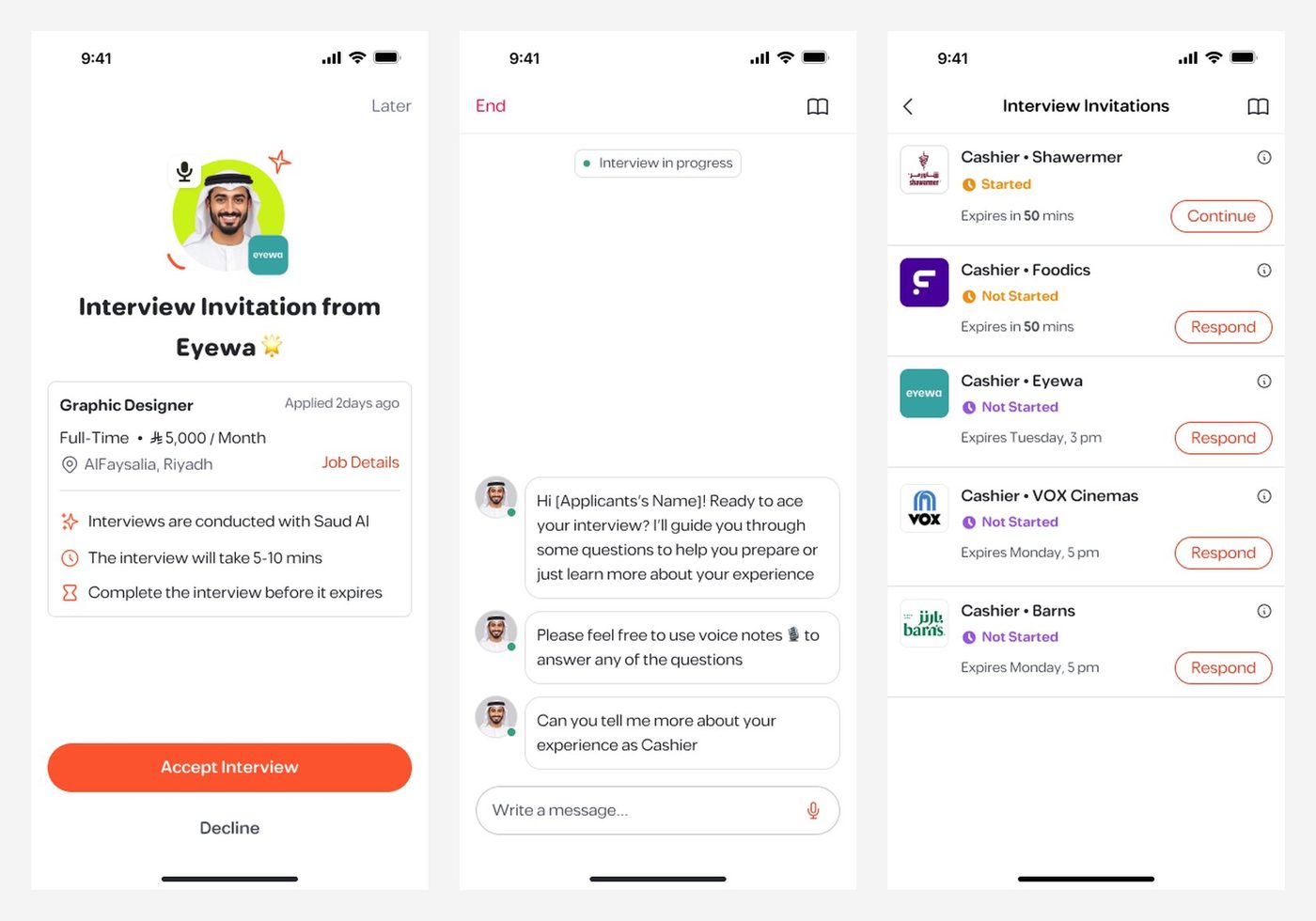
Saud interviews applicants on WhatsApp by text or voice, at whatever time suits each of them. A hundred interviews in a day do not need a hundred calls from your team.
Auto interviews on your criteria
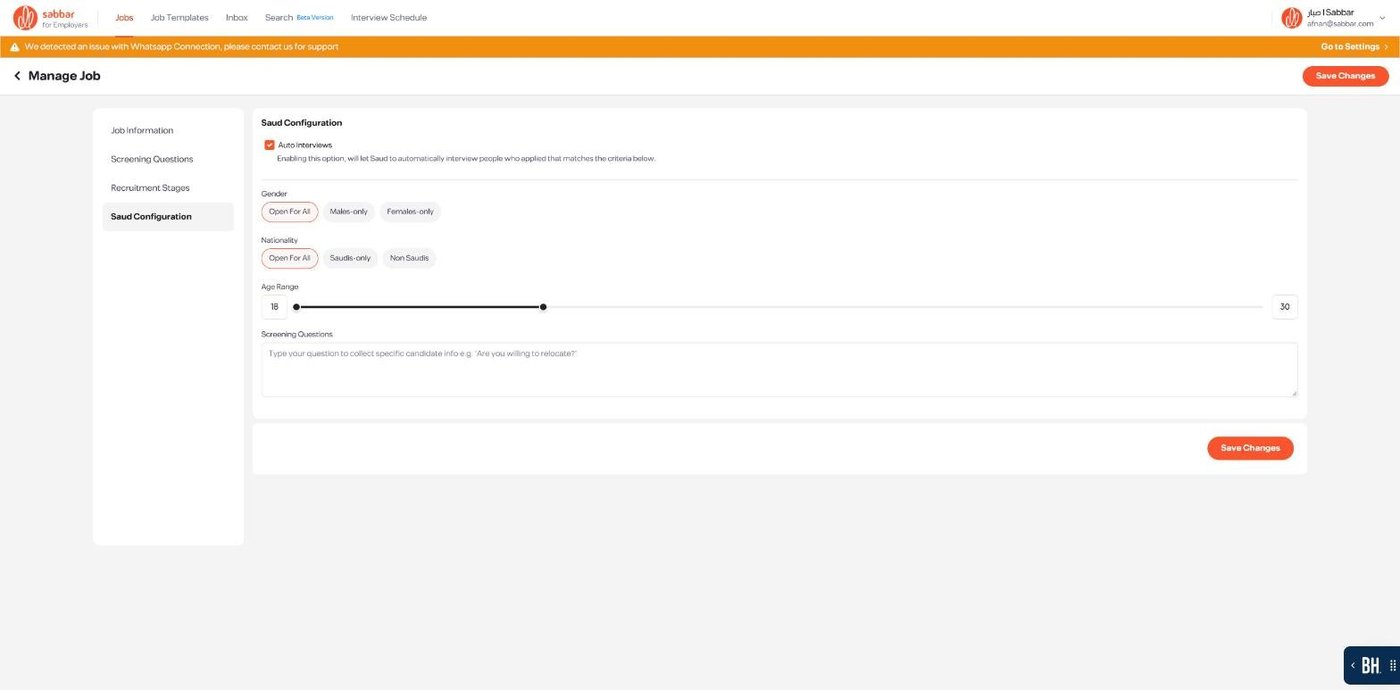
On the Enterprise plan you configure "Auto interviews": you set criteria such as nationality and age range, write your own questions, and Saud automatically interviews everyone who matches.
Branch openings coming up, or a season around the corner? Book a Saud demo and plan the hiring campaign with the team before the pressure starts.

Sabbar is Saudi Arabia's leading local hiring platform
The go-to place for job seekers and employers across every sector in the Kingdom, with more than 1.5 million job seekers and thousands of companies
Get started with Sabbar today!
Sabbar's tools for multi-branch hiring
The multi-branch tools are part of the Enterprise plan, built for companies that hire continuously.
- Always hiring: a job with no closing date that takes applicants all year.
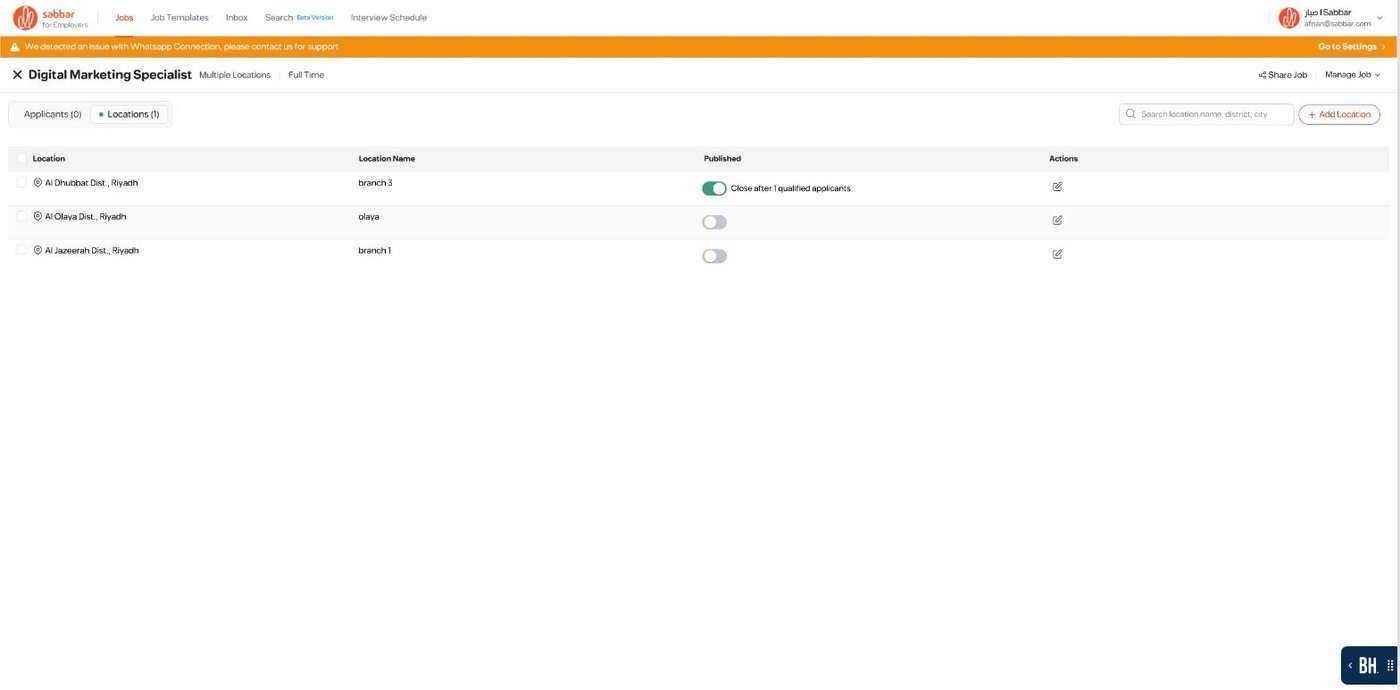
- Job Locations: one job across many branches, each with its own publish switch.
- Auto-close per branch: a branch closes automatically once Saud finds enough qualified applicants.
- Nearest branch for the applicant: job seekers see the branch closest to their home in the app.
- Interview scheduling: a list of scheduled interviews and the slots you make available.
A 5-step plan for a mass hiring campaign
A mass hiring campaign works when it starts with clear numbers and ends with a daily review.
- Set the number per branch: how many cashiers and baristas per site, and the start date.
- Standardise the job description: one description per title, used across all branches.
- Set Saud's criteria and questions: experience, shift availability and distance.
- Reserve final interview slots: one or two days a week per area.
- Review the numbers daily: applicants, those interviewed by Saud, and those shortlisted.
What is left for the hiring team?
The hiring team's role shifts from execution to decision. Instead of reading CVs and making calls, the team focuses on three things.
- The final interview with the people Saud recommended.
- Agreeing start dates with branch managers.
- Tracking the quality of hires and adjusting the criteria.
The case study of Hamburgini staffing 80 people in 48 hours shows how fast volume hiring can move when the early stages are not a bottleneck.
If your chain hires in more than one city, talk to the Saud team about setting up a single job that covers every branch.
An illustrative example: opening three branches before Ramadan
This illustrates a timeline; it is not a real customer case. A restaurant chain is opening three branches in Jeddah and needs a full crew for each one two weeks before Ramadan.
- Week one: the team sets the headcount per branch and per title, standardises the job description, and publishes one multi-location post covering the three branches.
- Week two: applicants arrive and Saud interviews them on WhatsApp against the criteria and questions you set. Each applicant is pointed to the branch nearest their home.
- Week three: branch managers hold final interviews on two fixed days per branch, working from Saud's summaries.
- Week four: offers go out, documents are collected, and new hires are trained before opening.
- After opening: a branch that reached its headcount closes, and branches that still need people stay open without reposting.
The point is that a two-person hiring team can run a campaign like this, because screening and first interviews do not pass through them.
Indicators to track daily in a mass hiring campaign
A campaign that is not measured falls behind without anyone noticing. Track these per branch.
- Applicants per branch: shows which branch needs more visibility or a salary review.
- Share who completed the Saud interview: a low figure means invitations need follow-up or the requirements are unclear.
- Good Fits among those interviewed: if low, review the criteria, which may be above the market.
- Attendance at the final interview: a direct sign of candidate seriousness and of how well reminders work.
- Hired against target: the number management cares about in the end.
- People who actually started: accepting an offer is not the same as turning up on day one.
How to reduce no-shows at interviews and on day one
No-shows are the biggest waste in mass hiring. These practical measures reduce them.
- Choose candidates close to the branch: distance is the first cause of absence and early resignation.
- Book quickly: the shorter the gap between the Saud interview and the final interview, the fewer drop-outs.
- Rely on pre-interview follow-up: Saud follows up with the candidate before the appointment and reminds them.
- Make everything clear early: salary, shift and branch location should be known before the interview, not after.
- Keep a reserve list: hold Close Fit candidates for each branch to replace anyone who withdraws.
Common mistakes in mass hiring
These mistakes come up again and again in opening and seasonal campaigns.
- Starting late: a campaign needs weeks. Starting days before the season means hiring whoever is available, not whoever fits.
- One generic post for all cities: candidates want to know the branch near them. Use Job Locations.
- Different criteria in each branch: every branch manager assesses in their own way and quality varies. Standardise the description and criteria.
- Leaving Saudization out of the plan: work out the required share of Saudi nationals from the start so you do not rehire later.
- Stopping after opening: turnover in these roles is high, and keeping an Always Hiring job open protects you from sudden vacancies.
Hire for every branch with one campaign run by Saud
Saud screens applicants, interviews them on WhatsApp and prepares a shortlist per branch, while your team concentrates on the final interview. Book a demo and start planning your next campaign.
Summary
Mass hiring in restaurants and retail no longer needs a large team. Saud by Sabbar screens, interviews and ranks candidates for each branch, and tools such as Always hiring and Job Locations let one job serve dozens of branches across Saudi cities.
FAQs about mass hiring with Saud
How many applicants can Saud interview?
Saud interviews applicants in parallel on WhatsApp, so the number of interviews does not depend on the size of your team.
Do I need a separate job post for each branch?
No. On the Enterprise plan you publish one job and add several locations, each with its own publish switch and auto-close.
Does it suit seasonal hiring?
Yes. Seasonal hiring benefits most, because volumes are high and the window is short.
Are auto interviews available in every plan?
Saud AI Interviews come with Premium and Premium Plus. Configuring auto interviews with your own criteria and questions is part of Enterprise.
Does the applicant see the branch nearest to them?
Yes. For multi-branch jobs, the Sabbar app shows job seekers the branch closest to them.