


Your co-op term is coming, the university wants a host organisation, and most companies never answer emails. Finding an internship in Saudi Arabia wears every student down, even though it is the first real line on a CV.
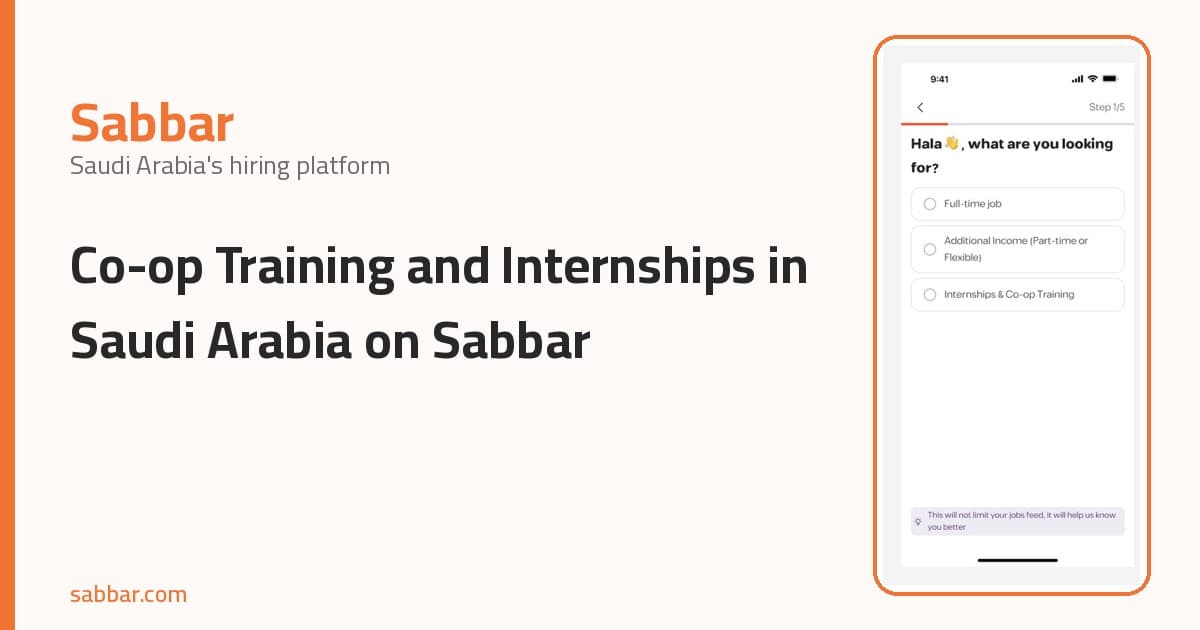
Sabbar has a contract type for internships and an internship option from the first sign-up step. This article explains how to find openings, prepare your profile as a student, and make the most of the placement.
What you will learn
- How co-op training differs from on-the-job training.
- How to find internship openings on Sabbar.
- How to write a student CV with no experience.
- What Sabbar's own COOP programme is, and how to succeed in a placement.
What is an internship in Saudi Arabia?
An internship in Saudi Arabia is a training placement at a real workplace. For students it is often co-op training, a graduation requirement that usually runs a semester or more depending on the university or college.
Related forms:
- Co-op training (COOP): for university and college students, tied to the study plan.
- Summer training: shorter, during the break.
- On-the-job training: for fresh graduates, learning a role inside a company, supported by national programmes such as those of the Human Resources Development Fund.
Check each programme's conditions and benefits with its organiser, as they are updated regularly.
How do you find internship openings on Sabbar?
You find them in three ways.
1. At sign-up
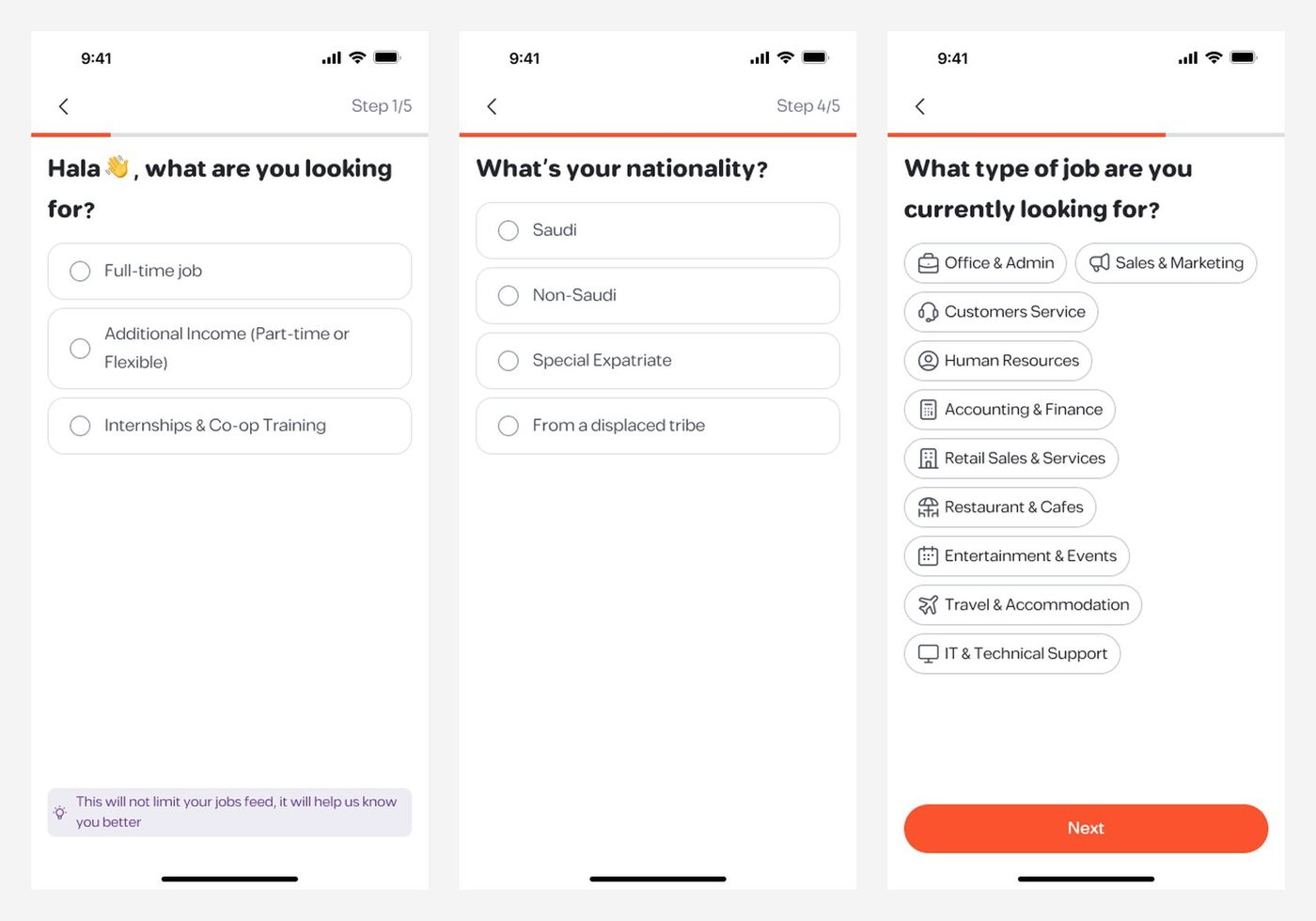
The app asks "what are you looking for?" Choose "Internships & Co-op Training" and your feed is built on that.
2. With the contract type filter
In search, open the filters and choose contract type "Internship". Add "No experience" to widen results.
3. With job alerts
Save the search as an alert to be notified when a new opening is posted. Internship places are limited and close quickly.
Sabbar's website also has a quick filter for fresh graduates. Search is covered in Job search on Sabbar: filters and job alerts.
Start looking before your classmates. Browse jobs and openings on Sabbar and choose contract type "Internship" in the filters.

Sabbar is Saudi Arabia's leading local hiring platform
The go-to place for job seekers and employers across every sector in the Kingdom, with more than 1.5 million job seekers and thousands of companies
Get started with Sabbar today!
What is Sabbar's COOP internship programme?
Sabbar itself runs a COOP internship programme for students within its team, with three tracks.
- Marketing and digital communication.
- Technology and product.
- Business.
Each intern works with a mentor from the team. Application details are on Sabbar's internship programme page. Past interns describe the experience in posts such as this product development internship story.
How do you write a student CV for an internship?
Write it around what you have learned and what you can offer, not what you lack.
- About Me: "[Field] student at [university], looking for a [length] co-op placement starting in [month]."
- Education: field, level, and GPA if it is good.
- Study projects: one or two, with exactly what you did.
- Activities: student clubs, volunteering, organising events.
- Skills: software, languages, communication.
- Courses and certificates.
The CV sections are covered in One CV for every job in Saudi Arabia.
Which fields take interns?
Most sectors take interns; these lead.
- Marketing and sales.
- HR and recruitment.
- Accounting and finance.
- Technology and data analysis.
- Customer service and operations.
- Hospitality, tourism and events.
- Retail and branch management.
How do you raise your chances of being accepted?
Raise them by applying early with a profile that shows commitment.
- Apply at least two months before the term.
- Add an introductory video: one minute on your field and what you want to learn. See Video introduction for your CV.
- State the placement length and dates clearly.
- Have the university letter ready: to send as soon as asked.
- Reply quickly: to messages and interview invitations.
- Be flexible on location and field.
What should you ask before accepting a placement?
- What will I actually work on?
- Who will supervise me?
- Is there a stipend, and what are the days and hours?
- Will you sign the university's forms and evaluation?
- Is there a chance of a job afterwards?
How do you succeed during the placement?
Doing well turns a graduation requirement into a job offer.
- Arrive on time; it is the first thing noticed.
- Ask plenty of questions in week one.
- Note what you learn each day.
- Ask for a real task, not just shadowing.
- Ask your supervisor for feedback halfway through.
- Ask for a written recommendation at the end.
Then add the internship to your Sabbar CV straight away, with duties and results.
What comes after the internship?
After the internship you move on to your first job, now with real experience on your CV.
- Change "what are you looking for" to a full-time job in Work Preferences.
- Use the "No experience" filter and the fresh graduates quick filter.
- Try part-time work while studying. See Part-time and no-experience jobs in Saudi Arabia.
Are internship openings on Sabbar safe?
Sabbar jobs are published after the company's account is reviewed. Keep to the fixed rule: never pay for training or a certificate. A real internship charges the intern nothing.
Your student profile takes fifteen minutes. Download the Sabbar app and choose "Internships & Co-op Training" at sign-up.
An illustrative example: a student's plan three months before training
This illustrates a timeline; it is not a real case. A marketing student at a university in Riyadh starts her co-op training in three months.
- Three months before: she gets the training letter and its requirements from her university: duration, hours and the evaluation form.
- The same week: she signs up on Sabbar, chooses "Internship and co-op training", and builds her CV with two study projects and her role in the marketing club.
- Two and a half months before: she saves an alert for the Internship contract type in Riyadh and applies to every suitable opening on the day it is posted.
- Two months before: she follows up replies and attends interviews, asking each employer what an intern actually does.
- Six weeks before: she chooses the employer and confirms it will complete the university's forms.
- Before starting: she hands the letters to her university and agrees training goals with her supervisor.
Applying early gave her a choice between several employers instead of taking the first offer.
Questions to ask a training employer before you accept
Not every training opportunity is useful. Some employers give interns tasks unrelated to their major. These questions reveal the quality of the opportunity.
- What will I work on each week? A specific answer is a good sign.
- Who will supervise me directly? A named supervisor means real follow-up.
- Is there a stipend or allowance? Ask plainly. Employers differ.
- Will you sign the university forms and the final evaluation? Essential for the training to count.
- What are the days and hours? And is any of it remote?
- Have you hired previous interns after training? It shows how seriously the employer invests in interns.
How to get value from every week of training
Training is short, and anyone who does not plan it leaves with only an attendance certificate.
- Week one: understand the team and tools, and ask for a list of what is expected of you.
- The following weeks: ask for a task with a clear outcome, such as a report, a campaign or an analysis, not only scattered tasks.
- Every week: note what you learned and achieved, with numbers where possible.
- Mid-way: ask your supervisor for feedback and what to improve.
- The last week: ask for a reference letter, and ask about jobs after graduation.
The weekly log you keep becomes the material for your CV after training.
How to turn training into a strong first line on your CV
Many students write "co-op training at company X" and stop. The details make the difference.
- Write the title and duration: "Marketing Intern, four months."
- Write three duties with clear verbs: prepared, analysed, took part in.
- Give at least one result: a report that was adopted, or a campaign you helped run.
- Add the skills you gained: a tool, software or way of working.
- Update your summary: from "student looking for training" to "graduate with training experience in".
Common mistakes when looking for co-op training
- Starting late: two weeks before the semester, most places are taken.
- Applying to one employer: apply to several at the same time.
- Accepting any offer without asking about the tasks: you may spend months on work that adds nothing.
- An empty CV: study projects and activities fill what you think is a gap.
- Ignoring university requirements: confirm the employer accepts the forms before you start.
Find your placement from your phone and apply today
Internship openings and graduate jobs from companies across Saudi cities. Filter by contract type "Internship", apply with one CV for free, and start the first experience of your career.
Summary
To find an internship in Saudi Arabia on Sabbar, choose "Internships & Co-op Training" at sign-up, use the "Internship" contract type filter and save an alert. Prepare a CV that shows your projects and skills, apply early, and turn the placement into your first real experience.
FAQs about co-op training and internships on Sabbar
Does Sabbar have internship openings for students?
Yes. Find them under contract type "Internship" and through the internship option at sign-up.
Is applying for internships free?
Yes, completely free.
What do I write on my CV with no experience?
Study projects, student activities, volunteering, skills and courses.
Does Sabbar itself offer co-op training?
Yes. It runs a COOP internship programme with marketing, technology and business tracks, each with a mentor.
When should I start looking for an internship?
At least two months before the training term.