As hiring volume grows, a company starts looking for a tool to tame the chaos, and the first name raised is an applicant tracking system, or ATS. Then another option appears: an AI hiring assistant such as Saud by Sabbar. Are they the same thing, and which does your company need?
This article compares them one criterion at a time, without jargon, and shows when one is enough and when each completes the other.
What you will learn
- What an applicant tracking system is, and what Saud is.
- How they differ on seven criteria.
- The situations each option suits.
- Questions to ask before deciding.
What is an applicant tracking system (ATS)?
An applicant tracking system is software that collects job applications in one place and organises them through stages: applied, screened, interviewed, offered, hired. Its core job is organisation and record-keeping.
A traditional system stores and sorts, but it waits for your team to read CVs, call and book slots. Some add keyword filtering.
What is Saud?
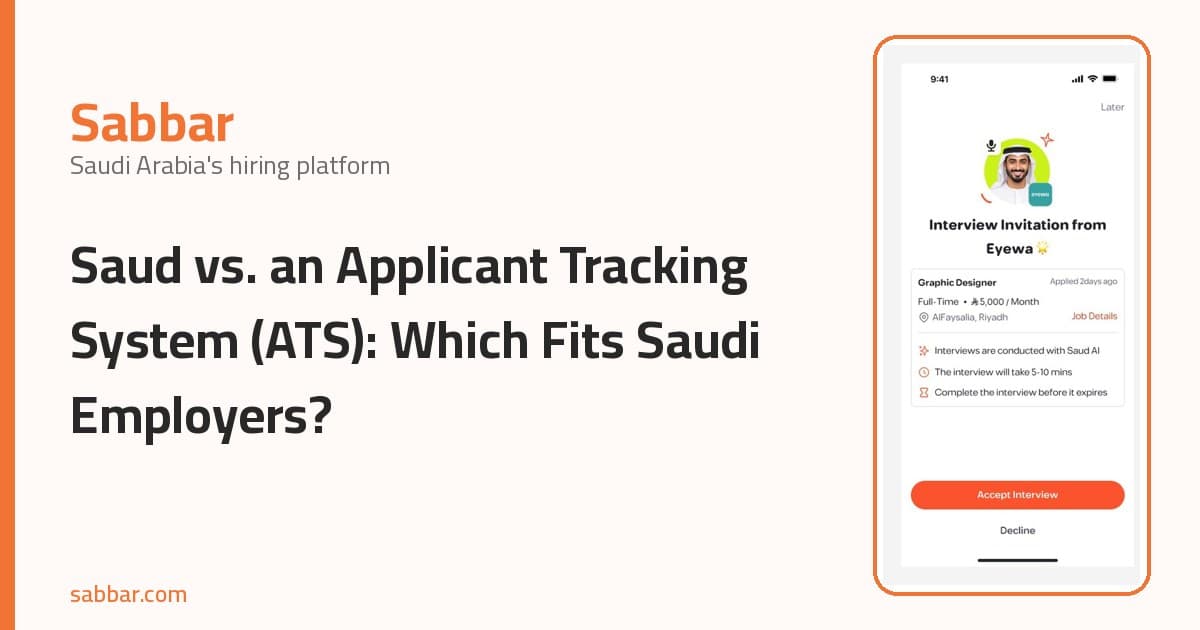
Saud is the AI hiring assistant from Sabbar. He does more than organise applications; he carries out tasks: rating an applicant's fit, running the first interview on WhatsApp, agreeing the interview slot and following up before the day.
Saud works inside the Sabbar platform, which has more than 1.5 million job seekers and a hiring stages board. The full definition is in What Is Saud by Sabbar?.
How do Saud and an applicant tracking system differ?
The core difference: an ATS organises the work, and Saud does part of it. Seven criteria:
Core function
An applicant tracking system is a database and a workflow. Saud is an assistant who interacts with every applicant and gives you a finished result.
Candidate source
An ATS does not bring candidates; it depends on what you post on your channels. Saud works on a platform with an active job seeker base, so source and tool are in one place.
Screening
Screening in traditional systems is manual or keyword-based. Saud compares the job's structured requirements with the applicant's data and gives a Good Fit or Close Fit rating with a written reason.
The first interview
An ATS records the outcome of an interview a person held. Saud holds the first interview himself on WhatsApp, by text or voice, and writes his notes and the transcript.
Want to see the difference on one of your own roles? Book a Saud demo and watch the screening, the interview and the summary.

Sabbar is Saudi Arabia's leading local hiring platform
The go-to place for job seekers and employers across every sector in the Kingdom, with more than 1.5 million job seekers and thousands of companies
Get started with Sabbar today!
Contact with candidates
Most systems rely on email. Saud uses WhatsApp, the channel candidates in Saudi Arabia answer, especially for frontline roles.
Setup and running
An ATS usually needs configuration, team training and connections to posting channels. Saud works inside your company's Sabbar account, and his results appear on the applicant's profile with no technical project.
Cost
Applicant tracking systems are usually sold as a recurring subscription. On Sabbar you post for free, plans are a one-time payment with no auto-renewal, and a Saud interview is counted only when it happens.
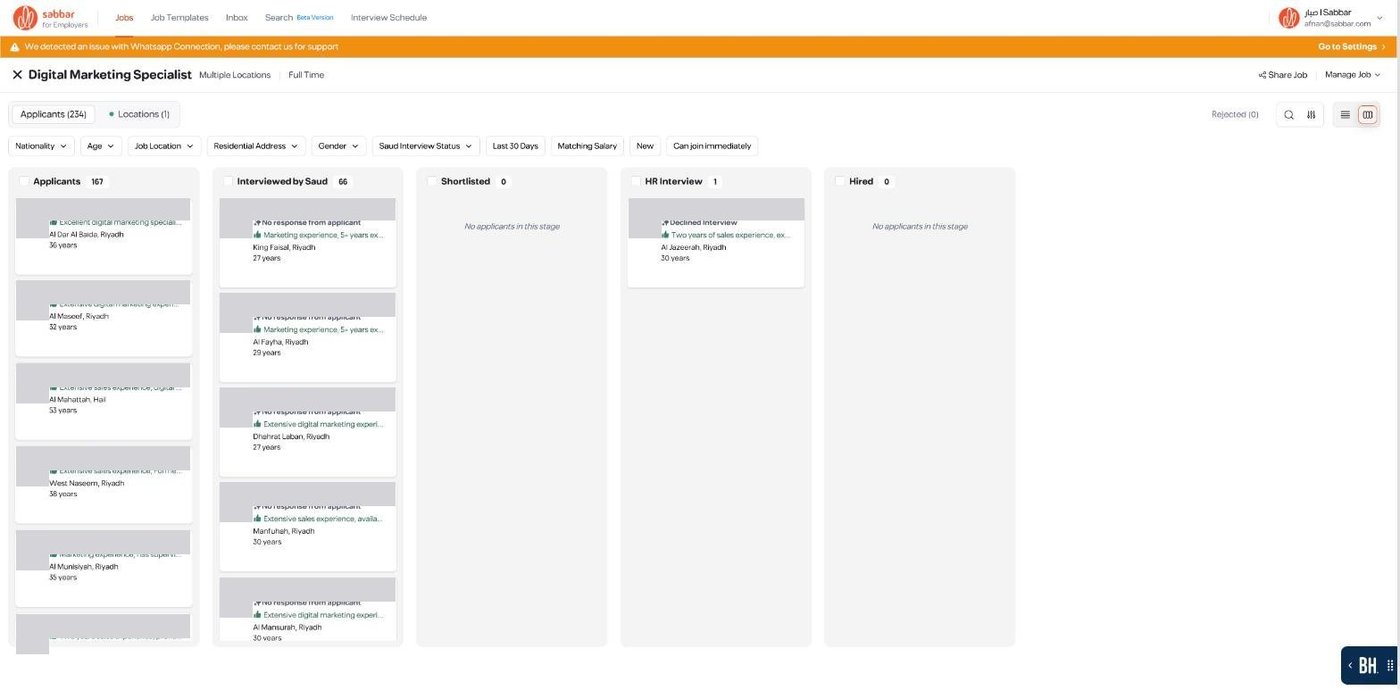
Does Sabbar cover what an ATS does?
Sabbar has tools that cover much of what an applicant tracking system offers, for hiring through the platform.
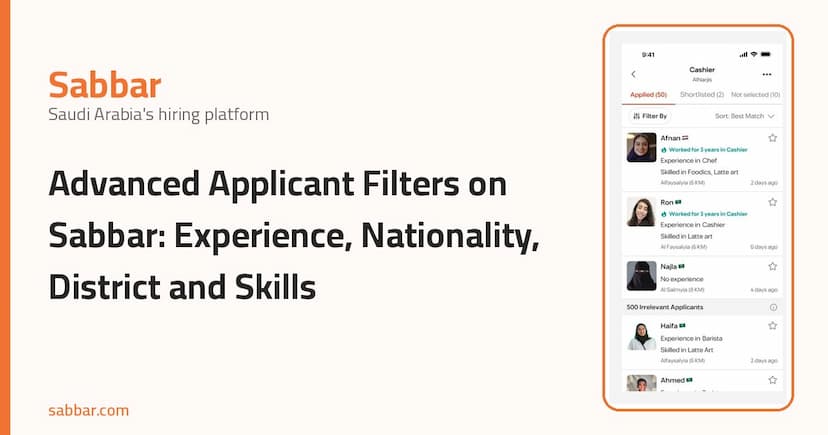
- A stages board: Applicants, Interviewed by Saud, Shortlisted, Hired, plus custom stages.
- A profile per applicant: CV, chat, interview and notes.
- Users and roles: Recruitment Manager and Recruiter, with unlimited users.
- Advanced filters and your own rejection reasons.
- Job templates: on the Enterprise plan.
These tools manage applicants who come through Sabbar. If your company receives applications from many other channels and needs one record for all of them, that is the job of a general ATS.
When does an applicant tracking system suit you?
A general ATS suits you in these cases.
- Hiring from multiple channels with a need for one record.
- Specialist roles with low volume and long cycles.
- Detailed internal documentation and reporting requirements.
- A large hiring team with several approval steps.
When does Saud suit you?
Saud suits you in these cases.
- Large numbers of applicants for recurring roles.
- Frontline roles in restaurants, retail and services.
- A small hiring team with no time for first calls.
- Seasonal or multi-branch hiring.
- A need for quick results without a technical project.
See AI mass hiring for restaurant and retail chains.
Can you use both?
Yes, and many large companies do: a general system for the whole hiring record, and Saud for the heaviest stage, screening and first interviews for high-volume roles.
Combining them makes sense because each solves a different problem. The first answers "where is each application?" and the second answers "who among these deserves my time?".
6 questions to ask before deciding
- How many applicants do I get per job on average?
- How many hours a week does my team spend reading and calling?
- Is my problem organisation or workload?
- Where do my candidates come from today?
- Are my roles recurring or specialist?
- Do I have technical staff to run a new system?
If your problem is volume and time, start with Saud. If it is record-keeping across many channels, start with an ATS. For background, read AI in HR in Saudi Arabia.
Not sure where your company sits? Talk to the Saud team, describe your situation, and get a frank answer on what fits.
An illustrative example: three companies, three decisions
These illustrate how to think about the choice. They are not customer cases.
- A café chain with twenty branches: hires baristas and cashiers every month and receives hundreds of applicants. Its problem is not organising records but the time spent screening and calling. Saud fits best, because the problem is execution.
- An engineering consultancy: hires a few engineers a year, from several channels, with a long cycle involving committees and approvals. A general applicant tracking system fits best, because the need is documentation and workflow.
- A large retail group: has office roles at head office and hundreds of frontline roles in branches. It uses both: a system for head office roles, and Saud on Sabbar for branch roles.
One question settles all three cases: where does your team's time go today, on organising applications or on dealing with each applicant?
How to find out where your team's time goes
Before you buy any tool, measure one week of the hiring team's work. Ask each member to log hours under five headings.
- Reading CVs and screening.
- First calls, including attempts that went unanswered.
- Scheduling and rescheduling.
- Data entry and reporting, and updating records.
- Final interviews and decisions.
If most time goes on the first three, your problem is execution, and an assistant like Saud addresses it. If it goes on the fourth, your problem is organisation, and an applicant tracking system addresses it. The fifth is what should grow in both cases.
What you gain and lose with each option
Every option has a price, and knowing it beforehand prevents disappointment.
- An ATS alone: you gain one record and reports, while reading, calling and scheduling stay with your team as before.
- Saud alone: you gain execution of the early stages and a ready candidate base, while applications from channels outside Sabbar still need another way of being organised.
- Both together: you gain organisation and execution, and need a clear internal agreement on which roles go through which route, so work is not duplicated.
A simple transition plan if you decide to try Saud
The transition needs no technical project. Four steps are enough.
- Pick one recurring role: the one that consumes most team time.
- Post it on Sabbar with clear requirements: experience, shift, location and salary in their fields.
- Switch on Saud AI Interviews: and read the summaries daily in the first week.
- Compare after a month: time to fill, team hours and attendance against your previous method.
Keep your current method for other roles during the trial. There is no need to change everything at once.
Common mistakes when choosing hiring tools
- Buying a tool because others did: start from your own problem.
- Expecting a system to fix a shortage of candidates: a tracking system organises applicants. It does not bring them.
- Neglecting candidate experience: a tool that is great for the team and tiring for applicants loses you candidates.
- Ignoring language and channel: in the Saudi market, Arabic and WhatsApp are not details.
- A long contract before a trial: test on one role before committing.
Try Saud before investing in a new system
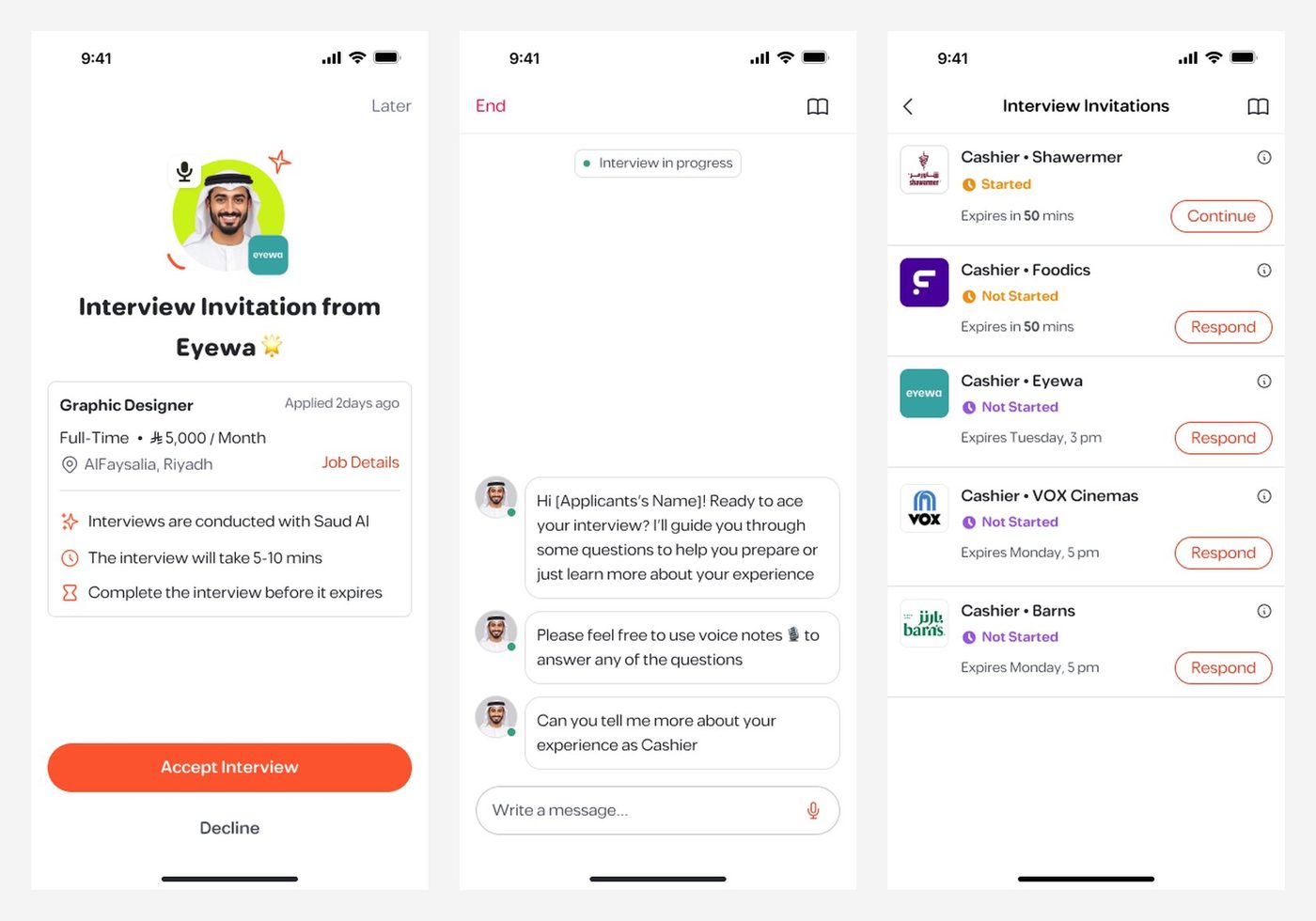
Saud needs no technical project and no monthly subscription. He works inside your company's Sabbar account, screening, interviewing and writing his notes. Book a demo and decide after you see the result.
Summary
An applicant tracking system organises and records applications; Saud carries out screening, the first interview and coordination. If your problem is volume and time, Saud is closer to what you need; if it is record-keeping across many channels, an ATS serves you; and you can use both.
FAQs about Saud and applicant tracking systems
Is Saud an ATS?
No. Saud is an AI hiring assistant that carries out tasks, working inside the Sabbar platform, which has a hiring stages board.
Do I need an ATS if I use Sabbar?
For hiring through Sabbar, the stages board and profiles are enough for most businesses. You need a general ATS if you want one record across many channels.
Does an ATS run interviews?
Traditional systems record and organise. Running the first interview automatically on WhatsApp is one of Saud's jobs.
Which is faster to get running?
Saud works inside your company's Sabbar account with no technical setup.
Is Saud a monthly subscription?
No. Sabbar plans are a one-time payment with no auto-renewal, and Saud AI Interviews come with Premium and Premium Plus.