A good question reveals in a minute what a two-page CV cannot. Asking the same screening questions of three hundred applicants, though, takes a whole team. That is where screening questions and auto interviews with Saud come in: you write the questions and criteria once, and Saud puts them to everyone who matches.
This article explains how to set them up for each job and which questions earn their place, with ready examples.
What you will learn
- How screening questions differ from auto interviews.
- Where to configure them on the Sabbar employer platform.
- How to write questions that give useful answers.
- Ready example questions for different roles.
What are screening questions and auto interviews?
Screening questions are short questions you add to a job to learn early what matters to you. You pick them from questions suggested for the job title or write your own.
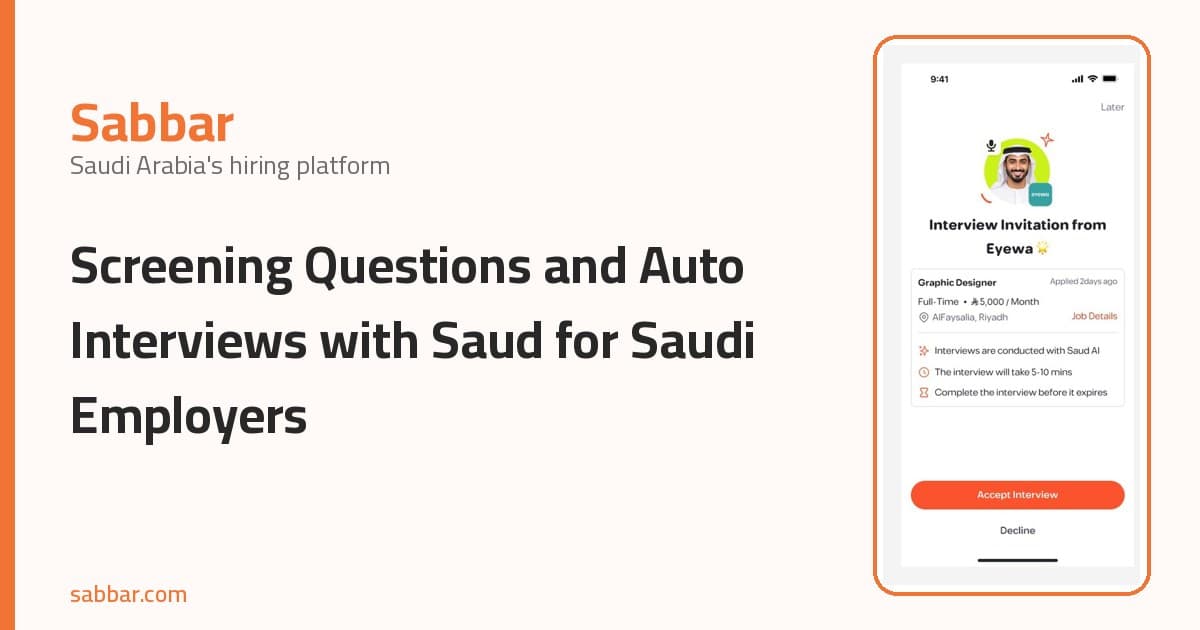
Auto interviews are a setting that makes Saud automatically interview applicants who meet criteria you define, using your questions. The criteria cover gender, nationality and age range.
Both are part of the Manage Job tools on the Enterprise plan. Saud AI Interviews themselves are available in Premium and Premium Plus. See AI interviews on WhatsApp with Saud.
Where do you configure them?
You configure them under Manage Job on the Sabbar employer platform, which has three sections.
- Screening questions: suggested for the title, or custom.
- Recruitment stages: fixed and custom.
- Saud Configuration "Auto interviews": criteria and questions.
For Always hiring jobs, Saud Configuration is the third step of creating the job.
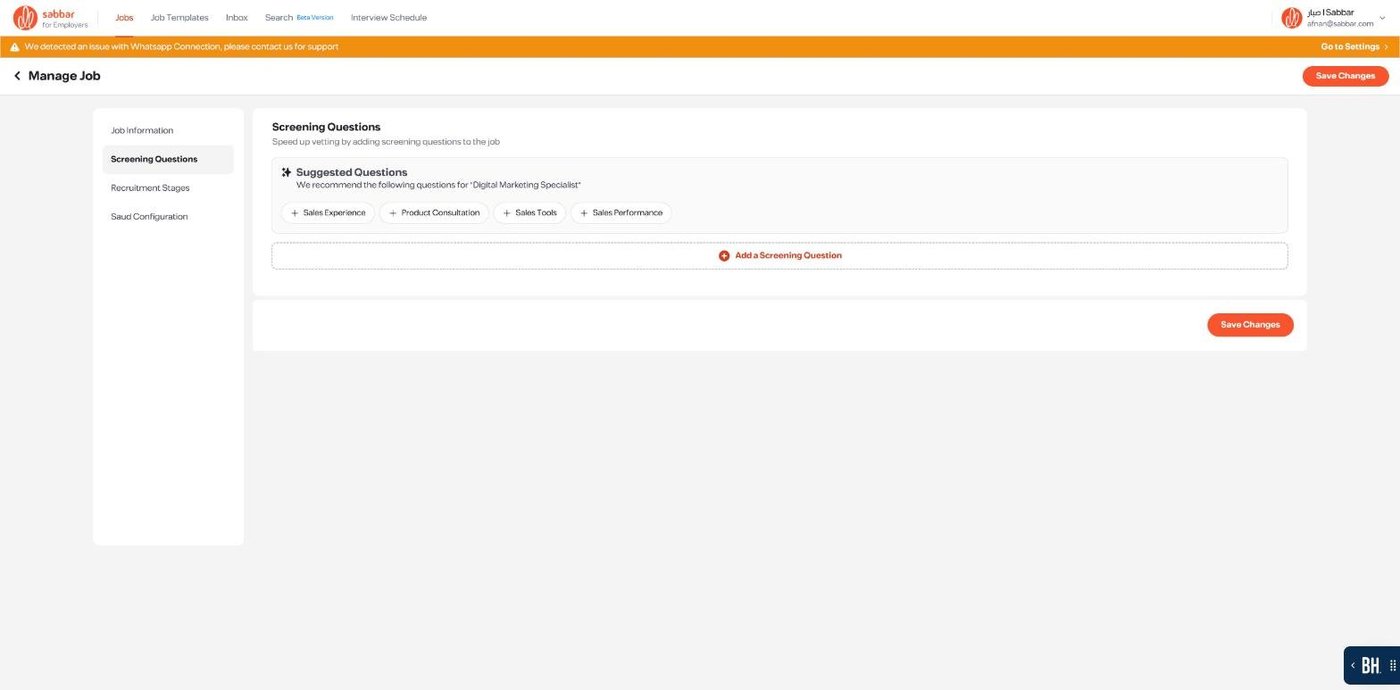
How do you set up auto interviews, step by step?
- Open the job and choose Manage Job.
- Add screening questions: pick suggested ones or write your own.
- Open Saud Configuration for auto interviews.
- Set the criteria for whom Saud interviews automatically.
- Add the interview questions you want asked.
- Save, then review the first batch of interviews and adjust.
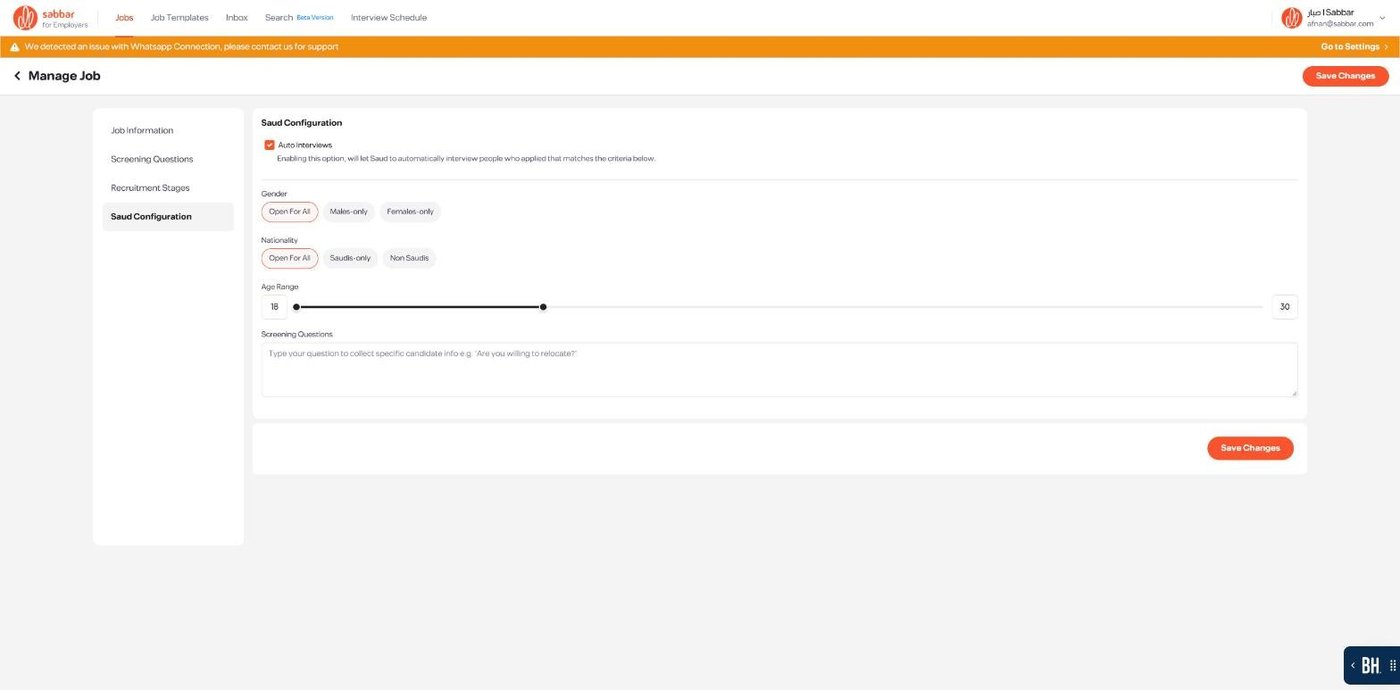
Want to see the setup on one of your roles? Book a Saud demo and the team will configure it with you.

Sabbar is Saudi Arabia's leading local hiring platform
The go-to place for job seekers and employers across every sector in the Kingdom, with more than 1.5 million job seekers and thousands of companies
Get started with Sabbar today!
How do you write a question that gets a useful answer?
A useful question is specific, tied to the job, and answerable in two or three sentences.
- Ask about a situation, not a trait: "Tell me about a time you dealt with an angry customer", not "Are you patient?".
- Ask about actions: "What did you do in your last job?".
- Ask about availability plainly: "Does an evening shift until midnight suit you?".
- One question at a time.
- Avoid yes/no questions: except for core conditions.
- Avoid anything that breaks the rules: keep questions professional.
How many questions should you add?
Five to seven is the right number. A first interview is short by nature, and too many questions make applicants drop out before finishing.
Order them like this:
- An opening question on experience.
- A question on previous duties.
- One or two situational questions.
- A question on availability and shifts.
- A question on start date.
Example questions by role
Cashier
- What is your experience with cash and point-of-sale systems?
- What do you do if the till is short at the end of a shift?
- There is a long queue and a rushed customer. What do you do?
Barista
- Which drinks do you make well?
- How do you keep quality and hygiene during rush hour?
- Have you worked early morning shifts?
Sales associate
- Describe how you open a conversation with a customer who just walked in.
- What is the biggest sales target you hit, and how?
- A customer is torn between two products. How do you help?
Customer service
- Tell me about a difficult complaint you resolved.
- How do you handle a request you have no authority to grant?
- Have you used ticketing systems or worked in a contact centre?
Security guard
- What is your experience at commercial or residential sites?
- How do you deal with someone who refuses instructions?
- Do night shifts suit you?
What do you receive after an auto interview?
You receive three things on each applicant's profile.
- A fit verdict: Good Fit, Close Fit or Not Fit.
- Saud Notes: a summary, matching points and unmatched points.
- The full transcript: the applicant's answers to your questions, word for word.
The applicant moves to the "Interviewed by Saud" stage on the board. Reviewing is covered in Candidate shortlisting with AI.
How do you know your questions are working?
Review the first twenty interviews and ask yourself:
- Do the answers help me tell candidates apart?
- Does everyone answer with the same sentence? Then the question is too general.
- Do many drop out midway? Then there are too many questions, or they are too long.
- Did the final interview reveal something I should have asked earlier?
Adjust accordingly. Good tuning takes two or three rounds.
Which criteria should you set for auto interviews?
Set criteria tied only to the job's requirements and the regulations.
- Base them on the nature of the work and its legal requirements, such as localized professions.
- Do not narrow them without reason, or you lose good candidates.
- Review them with your HR lead or legal adviser.
- Remember that every applicant stays on your list even if Saud did not interview them automatically.
What are custom rejection reasons, and when do they help?
In Recruitment Settings on Enterprise you define your own rejection reasons. They show why applicants are not accepted, such as distance, salary or availability, and from that you adjust the post and the questions.
For the wider picture of volume hiring, see AI mass hiring for restaurant and retail chains.
Hiring for many titles and need templates and questions for each? Talk to the Saud team and ask about job templates on Enterprise.
An illustrative example: a full setup for a sales associate role
This illustrates how to set things up; it is not a real company configuration. An electronics chain sets up a sales associate job for its branches.
Screening questions:
- Do you have retail sales experience? How long?
- Do evening shifts and weekends suit you?
- When can you start?
Auto interview criteria: at least one year of sales experience, and living in the city where the branch is.
Interview questions Saud asks:
- Tell us about your sales experience and the products you sold.
- A customer is comparing two devices and cannot decide. How do you help?
- A customer says the price is lower at another shop. What do you answer?
- Tell us about a time you missed your sales target and what you did next.
- Which shifts can you really work?
Five questions: one on experience, two on selling situations, one on handling failure and one on availability. Each has a clear purpose in the decision.
Every question needs a purpose: tie your questions to the decision
A question whose answer you would not act on does not deserve its place. Before adding one, write next to it what it settles.
- The experience question: settles whether the candidate meets the must-have.
- The situation question: reveals how they act, which is what most separates one candidate from another.
- The availability question: settles whether they fit the rota at all.
- The start date question: sets the priority for contact.
- The salary question: exposes a gap before the in-person interview.
If two questions settle the same thing, delete one. If a must-have has no question, add one for it.
How to review the first batch of answers and adjust
The first ten interviews test your questions, not only the candidates. Review them this way.
- Read the full transcript of several interviews: not the summary alone.
- Spot the question people keep misunderstanding: its wording needs simplifying.
- Spot the question everyone answers the same way: it does not separate candidates, so replace it.
- Spot the information you wish had been asked for: add a question for it.
- Compare the rating with your own judgment: if they differ often, review the criteria.
Adjust once after this review, then keep the questions fixed long enough to compare results.
Questions to avoid every time
Some questions add nothing to a professional decision, and some may breach regulations.
- Marital status, marriage plans and children.
- Origin, tribe and region.
- Health conditions unrelated to the job's requirements.
- Leading questions: "You do not mind unpaid overtime, do you?"
- Compound questions: three questions in one, where the candidate answers only one.
The rule: ask about what affects performance in the job, and leave the rest.
Common mistakes in setting up questions and interviews
- Copying the same questions to every job: a cashier is not a sales supervisor.
- Criteria that are too narrow: Saud interviews only a few, and your list stays empty.
- Criteria that are too wide: everyone is interviewed, and no screening happens.
- Long questions: the candidate reads on a phone. One line is enough.
- No review after setup: questions need adjusting after the first batch of interviews.
Write your questions once and let Saud ask every applicant
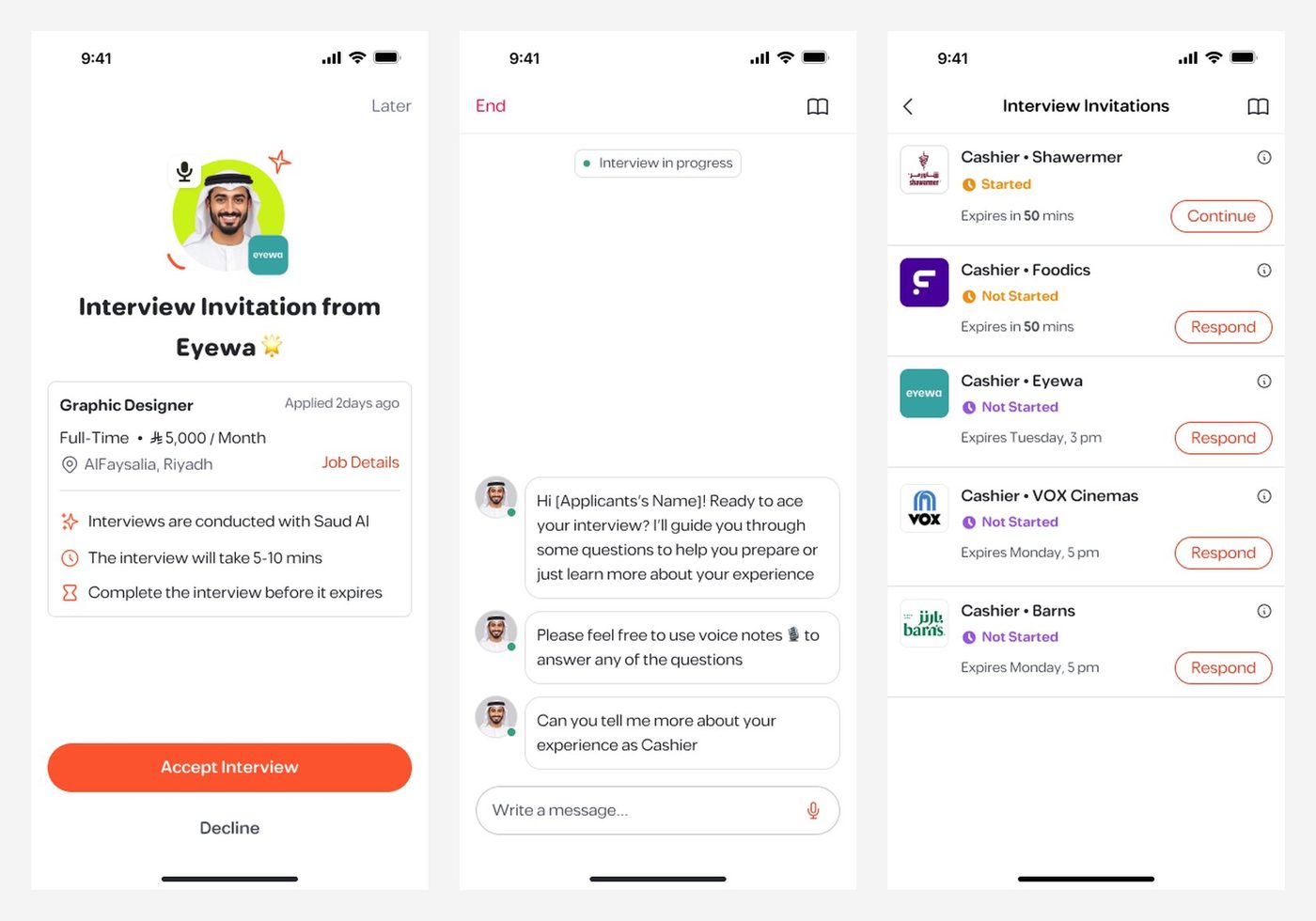
Set the criteria and questions for each job, and Saud interviews applicants on WhatsApp and sends you the answers and a verdict. Book a demo and configure your first job with the team.
Summary
Screening questions and auto interviews with Saud are set once per job: five to seven specific questions on experience, situations and availability, and criteria tied to the job. Saud asks everyone who matches, and you read the answers and decide.
FAQs about screening questions and auto interviews
Are screening questions available in every plan?
Screening questions and auto interviews are part of the Enterprise toolset. Saud AI Interviews are available in Premium and Premium Plus.
Can I write my own questions?
Yes. Pick from questions suggested for the title or write your own.
Do questions differ from job to job?
Yes. You set them for each job separately.
Can I read the applicant's full answers?
Yes. The full transcript is on the applicant's profile.
How many questions should an interview have?
Five to seven are enough for a short, useful first interview.